You know that feeling when someone in a meeting compliments your work, and your first thought - before the thank you even leaves your mouth - is "They have no idea who they're really dealing with"?
Or maybe it hits you differently. You get the promotion, the job offer, the acceptance letter you'd been hoping for, and instead of celebrating, you spend the night quietly terrified. Waiting for someone to figure out that you somehow fooled them. That you're not actually as capable as your résumé suggests. That it's only a matter of time before it all falls apart.
If you're reading this at 2am, heart doing something uncomfortable in your chest, this article is for you. Not for someone who has it figured out. Not for someone who just needs a productivity hack. For you, exactly as you are right now - exhausted, quietly convinced you don't belong, and wondering if everyone else feels this way or if you're somehow uniquely broken.
You're not broken. And you're not alone. But let's not just say that and move on, because you've probably heard it before and it hasn't helped much.
What's Actually Happening
Imposter syndrome isn't a character flaw. It's not even really a syndrome in the clinical sense. It's a pattern of thought - a story your mind tells you, on repeat, usually when the stakes feel high. Psychologists Pauline Clance and Suzanne Imes first named it in 1978 after noticing it almost exclusively in high-achieving women. Subsequent research found it everywhere. In surgeons, in CEOs, in artists, in academics. In people who, by every external measure, were genuinely excellent at what they did.
Here's the cruel irony: the more capable and conscientious you are, the more likely you are to feel this way. People who don't think carefully about their limitations rarely worry about them. The fact that you're questioning yourself, that you care about doing good work, that you notice the gap between where you are and where you want to be - that's not evidence of inadequacy. That's evidence of self-awareness.
But knowing that doesn't make the feeling go away. So let's talk about what might actually help.
Stop Trying to Feel Confident First
Most advice about imposter syndrome tells you to work on your mindset. Reframe your thinking. Build your confidence. Visualise success. And while there's nothing wrong with any of that, it often misses something fundamental: you don't need to feel confident before you act. You just need to act.
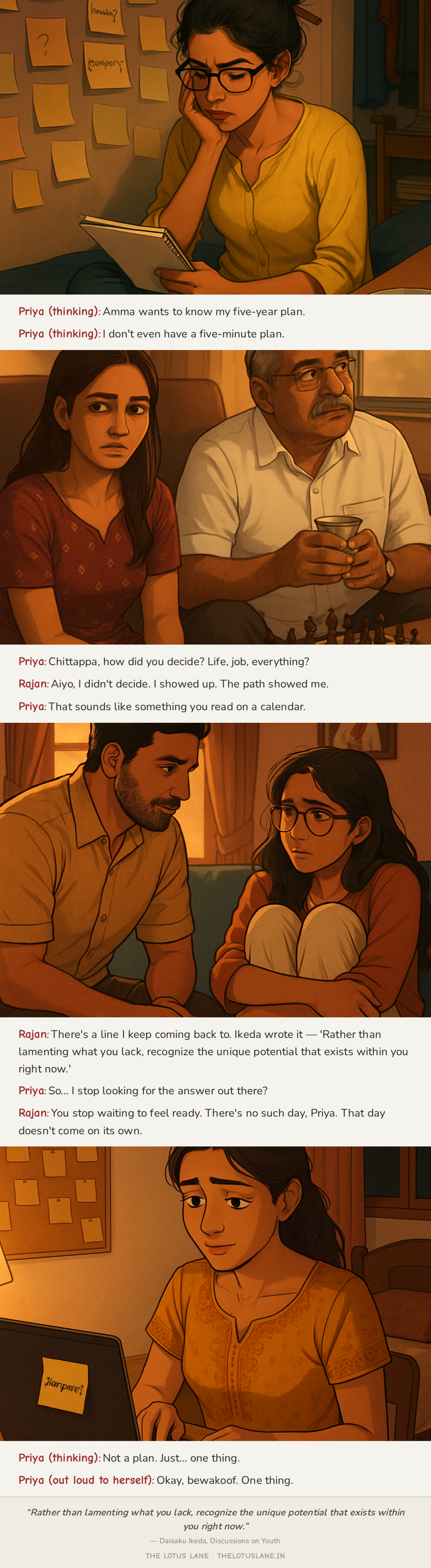
There's a line from a collection of philosophical writings that has stayed with me: "A hundred theories without a single action are worthless. Even one small step taken with determination changes everything."
This sounds simple. It isn't. When you feel like a fraud, the instinct is to prepare more. Read more. Study more. Wait until you're ready. But "ready" is a moving target. The preparation becomes a way of hiding. The person who feels like an imposter tells themselves they'll speak up in meetings once they know more, will apply for that role once they have more experience, will share their work once it's truly ready. And meanwhile, the silence and the waiting only make the fear louder.
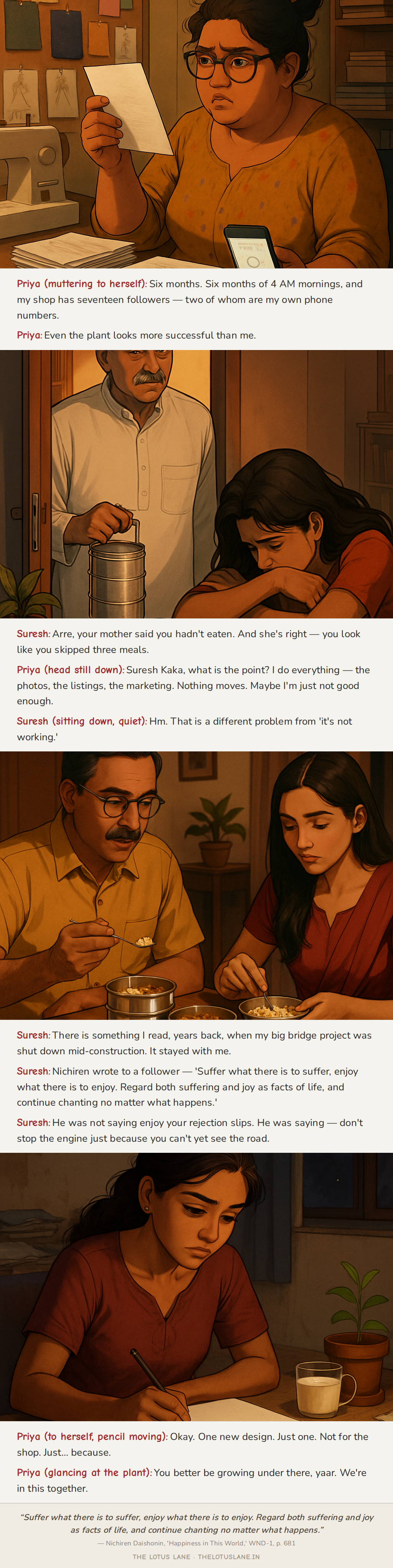
The antidote isn't confidence. It's action taken in the presence of fear. Small, specific, concrete action. Send the email. Make the suggestion. Submit the application. Not because you've stopped being scared, but because the action itself is what starts to change things.
Where These Feelings Usually Come From
Imposter syndrome doesn't appear out of nowhere. For a lot of people, it's rooted in something real from their past - messages they received about who gets to be successful, who belongs in certain rooms, who is "the type" to achieve things.
If you grew up being told to be modest, to not get ahead of yourself, to stay humble - those messages don't disappear when you enter a workplace. They follow you in. If you were the first in your family to go to university, or to step into a particular industry, or to earn above a certain income level, you're walking through territory without a map. Of course it feels uncertain. Of course part of you wonders if you've wandered somewhere you shouldn't be.
But "unfamiliar" doesn't mean "wrong." You're not trespassing. You're just in new territory.
It's also worth noting that some environments genuinely are unwelcoming. Some workplaces have cultures that make certain people feel like outsiders - and when that happens, what you're feeling isn't a cognitive distortion. It's an accurate reading of the room. The work then isn't just internal. It's also about finding communities and environments where your presence is genuinely valued, not just tolerated.
Practical Things That Actually Help
Write down what you've done, not just what you believe about yourself. Keep a simple document - even a notes app will do - where you record specific things you've accomplished. Not a formal CV. Just evidence. "Fixed that problem no one else could solve on Thursday." "Got positive feedback from someone I respect." "Figured it out even though I had no idea how at the start." When the imposter voice gets loud, you have something concrete to push back with.
Talk to someone you trust about what you're experiencing. Not to get reassurance - though that might come - but because saying the fear out loud tends to take some of its power away. The thought that lives only in your head at 2am is always larger and more convincing than the one you have to articulate in daylight to another person.
Notice the comparison trap. Imposter syndrome thrives on comparison, particularly the habit of comparing your inner experience to other people's outer performance. You see their competence and ease. They see yours. Neither of you sees the doubt behind the other's eyes. You are not the only one improvising.
Get curious about your discomfort instead of trying to immediately fix it. When the imposter feeling shows up, instead of fighting it, try asking: What is this protecting me from? What would I do if I weren't afraid of being found out? The answer to that second question is usually the thing most worth doing.
The Deeper Shift
Here's something that ancient thinkers understood, and that modern psychology is slowly catching up to: the way we change ourselves and the way we change our circumstances are not separate things. They happen together, through the same process of showing up differently, one moment at a time.
One philosopher put it this way - and these words have held up across centuries for good reason: "Human revolution is not something special or out of the ordinary. It is the process of transforming our lives, one challenge at a time."
That's worth sitting with. You don't have to have a dramatic breakthrough. You don't have to arrive at some permanent state of confidence or self-assurance. You just have to face the next challenge in front of you, honestly and as fully as you can. And then the one after that. That's the whole thing. That's all it ever is.
And perhaps more importantly: the change you make in yourself doesn't stay contained to you. It moves outward. Another collection of philosophical letters puts it plainly - that "a great human revolution in just a single individual will help achieve a change in the destiny of a nation and, further, will enable a change in the destiny of all humankind." That's not hyperbole. It's a recognition that when someone overcomes their own fear and shows up fully, it changes what's possible for the people around them too. When you stop hiding, someone else who was hiding sees that it's possible to step forward.
You Belong Here
Not because someone has officially declared you qualified. Not because you've finally achieved enough to silence the doubt. You belong because you're here, doing the work, caring about doing it well, and trying to figure out how to do it better. That's what belonging actually looks like from the inside - not certainty, but commitment.
The feeling that you're a fraud won't necessarily disappear. Many accomplished people have described carrying some version of it their entire lives. But it can become quieter. Less in charge. Less able to make your decisions for you.
You're already more than you think you are. The evidence is in what you've done, not in how you feel about it on a bad night.
Get some sleep if you can. Tomorrow, take one small step - not because you're ready, but because readiness isn't the point. Showing up is.