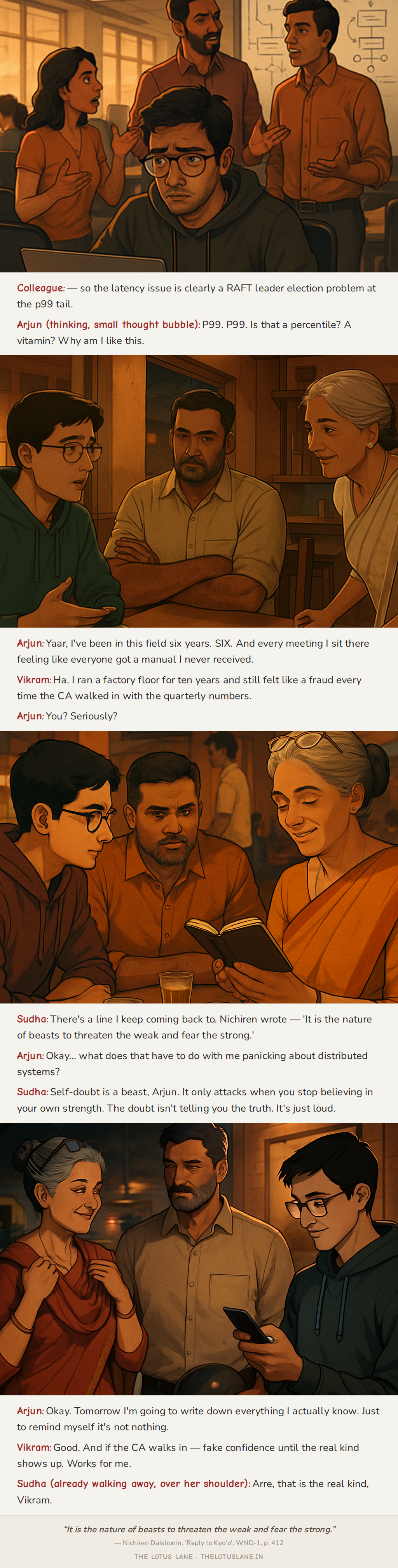
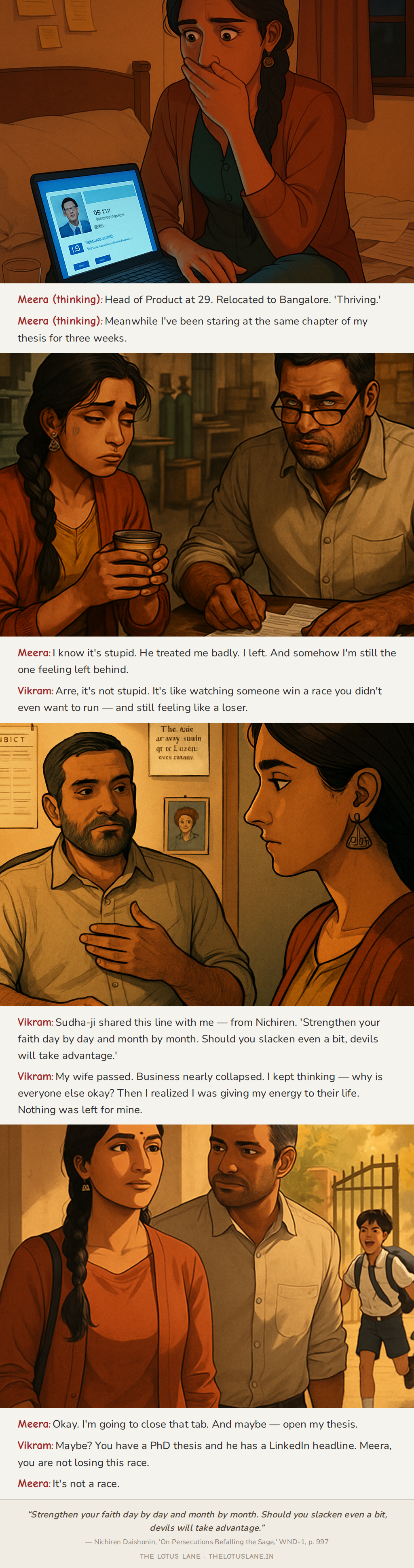
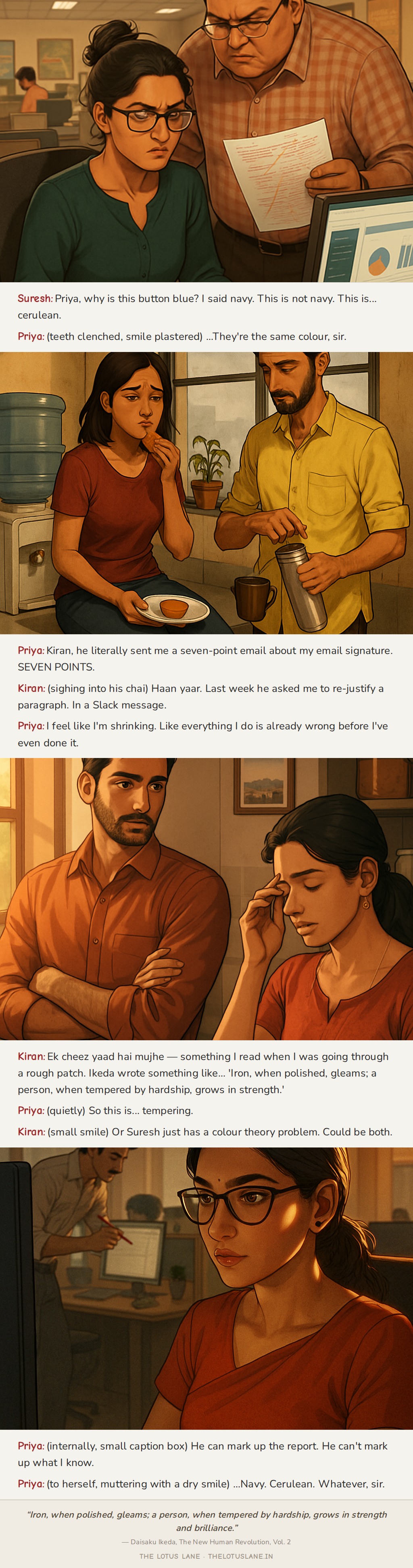
You know that feeling when it's late at night, the house is quiet, and you're lying there doing the mental math of your life? Counting up what you thought you'd have by now - the career, the apartment, the relationship, the sense that you've arrived somewhere - and realizing the numbers don't add up? That specific 2am flavour of dread, where your chest feels heavy and your phone screen is too bright and you're quietly, privately convinced that everyone else got a manual you never received?
Yeah. That feeling.
If you Googled your way here tonight, you're probably not looking for a motivational poster. You're not looking for someone to tell you to "believe in yourself" or "trust the process." You just want someone to be honest with you about what it actually feels like to be thirty-something and still feel like you're figuring out basic things that everyone else seems to have sorted out years ago.
So let's be honest.
The Story You're Telling Yourself (And Why It's Not the Whole Story)
Somewhere around 30, most of us absorb a very specific cultural message: that this is the age when life is supposed to crystallize. That the scattered, uncertain twenties were acceptable - even charming - but now it's time to have your act together. A stable income. A clear direction. A relationship that doesn't make you question your own sanity. Some kind of answer to the question: what are you doing with your life?
When that doesn't happen - or when it happens in the wrong order, or collapses after it looked like it was finally working - the story you tell yourself is a brutal one. I'm behind. I'm broken. I'm the only one who doesn't have this figured out.
Here's the thing about that story: it's constructed almost entirely from comparison. From the highlight reels of people you went to school with. From what your parents had accomplished by this age. From some imaginary version of yourself you've been carrying around since you were twenty-two and full of certainty about who you'd become.
That imaginary version of yourself isn't a goal. It's a ghost. And you've been haunting yourself with it.
What "Failure" Actually Means at 30
Let's talk about what failure actually is - not in the Instagram-caption sense, but in the real, uncomfortable sense.
Failing an exam is failure. A business going under is failure. Saying something cruel to someone you love is failure. These are specific events with specific consequences.
But being 32 and still figuring out your career path? That's not failure. That's a life being lived without a script, which is actually most lives, if people were being honest about it.
The feeling of being a failure - that low, constant hum of inadequacy - that's not a verdict. It's a symptom. It tells you something is hurting. It does not tell you who you are.
There's a line that stuck with me, from a collection of philosophical writings that have been passed down for centuries. It goes like this: "True victory is not about defeating others. It is about overcoming your own weakness, your own negativity, your own despair."
Read that again. Not defeating others. Not outperforming them, not arriving before them, not accumulating more than them. The actual work - the only work that matters - is internal. It's the slow, unglamorous process of not letting your own despair convince you of things that aren't true.
That's a harder fight than any external achievement. And you're in the middle of it right now.
Why 30 Feels So Specific (And Why That's Worth Understanding)
Thirty is a strange number because it's the first age that most of us experience as a deadline rather than a milestone. The twenties feel like a runway. Thirty feels like the plane was supposed to take off already and you're still taxiing.
But here's what nobody tells you: most of the people who look like they've taken off are just better at hiding their turbulence. The colleague who got promoted is quietly terrified she's not good enough. The friend with the picture-perfect relationship is having the same arguments on loop. The person whose life looks most together on the outside is often the one holding the most together with tape and prayer.
This isn't comforting in the "misery loves company" sense. It's comforting because it means the game you think you're losing? Most people aren't actually playing it. They're just surviving, like you are, and projecting confidence because that's what you do in public.
You're not behind. You're just not performing well-being as convincingly as some people have learned to.
Something Practical (Because Philosophy Alone Won't Get You Through the Night)
When you're in that 2am spiral, the worst thing you can do is try to solve your whole life. The second worst thing is to scroll your phone looking for evidence that you're okay, because the algorithm will serve you things that make you feel worse, not better.
Here's what actually helps - small, boring, human things:
Write down three things you did this week that required effort. Not achievements. Not things you're proud of. Just things that required you to show up when it would have been easier not to. Got out of bed when you didn't want to. Answered a difficult email. Cooked something instead of ordering in. These count. The muscles that carry you through hard periods are built from exactly this kind of quiet effort.
Talk to one person honestly. Not to perform your struggle - not to get reassurance - but just to say out loud: I'm having a hard time right now. There is something almost chemical about the relief of being witnessed by someone who isn't going to try to fix you.
Stop auditing your life at 2am. Seriously. The version of yourself making decisions at 2am after an hour of anxious spiraling is not a reliable narrator. Go to sleep. Hydrate. The same facts look different in daylight, not because the facts change, but because your capacity to interpret them does.
Do one small thing tomorrow that is aligned with who you want to be. Not a grand gesture. Not a life overhaul. One thing. Read for twenty minutes. Apply for one job. Make one phone call you've been avoiding. The path out of feeling stuck is almost always made of smaller steps than you expect.
The Longer Game
Here's where I want to ask you to hold something a little bigger, not as a platitude but as a genuine reframe.
The idea that your life is supposed to peak at 30, or that anything that hasn't happened by now is permanently out of reach - that's a remarkably recent cultural invention. For most of human history, people understood that a life was a long arc, and that what mattered was not where you were at any given checkpoint but the direction you were moving and the person you were becoming.
There's an old philosophical tradition that puts it this way: "Human revolution is not something special or out of the ordinary. It is the process of transforming our lives, one challenge at a time." One challenge at a time. Not one decade. Not one grand turning point. The smallest unit of change that actually works is one challenge. The one in front of you right now.
And then there's something else worth sitting with - a bigger idea that takes some time to absorb. The same tradition suggests that when a single person genuinely changes - when they move from despair to something more honest and more courageous - it creates a ripple. Not metaphorically. Actually. The people around you are affected by who you are becoming. Your kids, if you have them. Your friends. The strangers you interact with. As one philosopher wrote: "A great human revolution in just a single individual will help achieve a change in the destiny of a nation and, further, will enable a change in the destiny of all humankind."
That's not hyperbole. That's an invitation to take your own life seriously - not because you owe the world a success story, but because the work you do on yourself is never only about you. It spreads. Always.
What I Actually Want to Say to You
You are not a failure. You are a person in pain at 2am, which is one of the most human things there is.
The fact that you're here, reading this, asking these questions - that's not evidence of falling behind. That's evidence of someone who cares deeply about their own life and hasn't given up on it. That matters more than you know right now.
Thirty is not a verdict. It is not a deadline that has passed. It is a point in a life that is still very much in motion, even when it feels like everything has stalled.
The thing you're fighting tonight - the despair, the comparison, the story that you're not enough - that's the real battle. Not the job, not the relationship, not the apartment. The real battle is whether you can look at your own life with something approaching honesty and compassion, and choose, one small day at a time, not to give in to the version of yourself that has already decided it's over.
You haven't decided that. If you had, you wouldn't be here.
Go to sleep. Tomorrow is a different conversation.