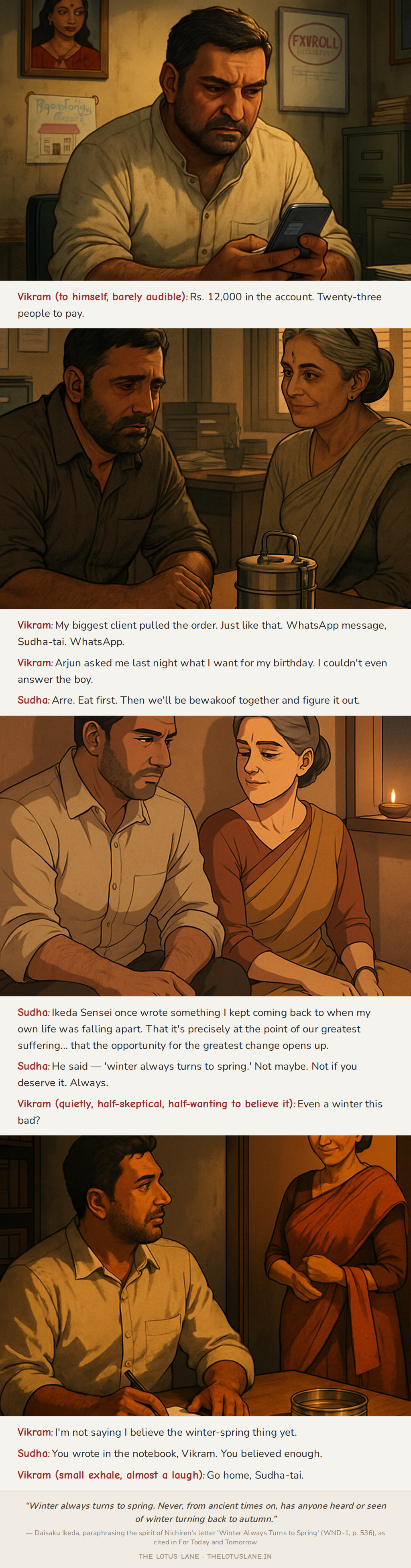
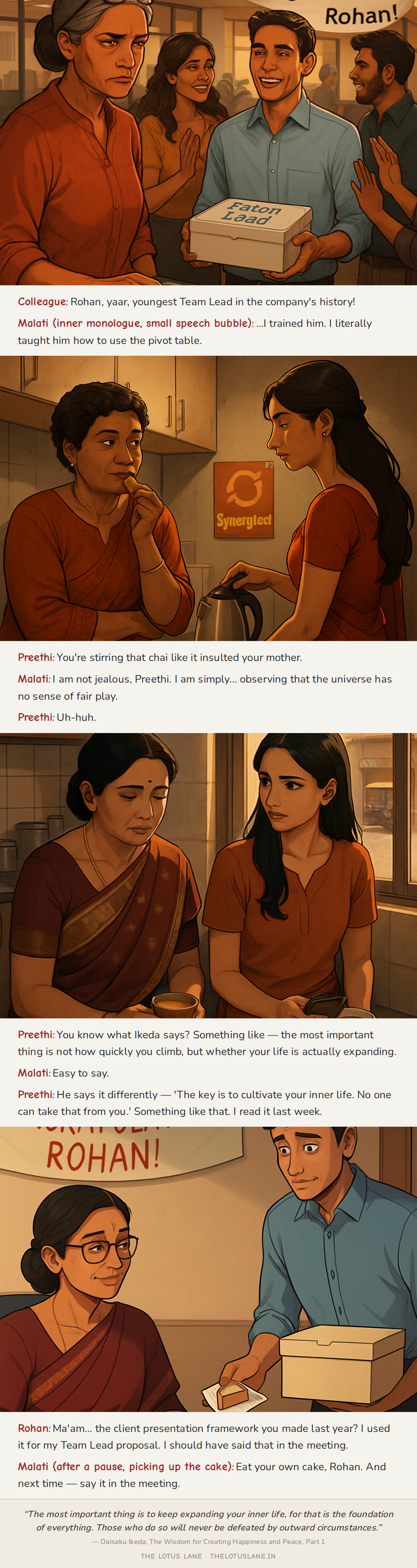
You know that feeling when someone asks the room a question, and you answer it, and then two minutes later someone else says almost exactly the same thing - and suddenly everyone's nodding and writing it down? You said the words. They got the credit. You sat there wondering if you'd actually spoken out loud, or if you'd somehow become furniture.
That's the feeling. And if you're reading this at some strange hour because it happened again today, or this week, or for the sixth month in a row - you're not imagining it. Something is wrong, and it hurts in a way that's hard to explain to people who haven't felt it.
Being invisible at work is one of those specific, grinding pains that doesn't come with a clean name. It's not harassment. It's not a demotion. It's not anything you can easily point to and say: here, this is the problem. You're still on the team. Still on the email chain. Still showing up. But you're no longer in the room in any way that counts. People talk around you. Over you. Through you. And after a while, you start to wonder if the problem is you.
First: It's Not All in Your Head
Let's get that out of the way before anything else. The self-doubt that comes with this experience is part of the experience. When you're consistently overlooked, your brain starts constructing explanations - and most of those explanations, because brains are unkind that way, will be about your own failings. Maybe you're not smart enough. Not confident enough. Not the right kind of person for this environment.
Some of that might have a grain of truth worth examining. But most of it is the story we tell ourselves when the situation is actually about power, about group dynamics, about who holds the invisible keys to belonging in a particular room. You didn't invent this feeling out of insecurity. Something real is happening.
The question is what to do about it - and that requires seeing the situation clearly before you do anything at all.
Seeing It As It Actually Is
There's a line that's stayed with me from a collection of philosophical writings: "Wisdom is the ability to see things as they really are, not as we wish them to be. And then to act accordingly."
That "and then to act accordingly" part is doing a lot of work. Because most of us, when we're invisible at work, are caught between two unhelpful versions of reality. One version is the wishful one: It'll get better on its own, maybe I just need to wait, maybe they'll notice eventually. The other version is the catastrophic one: This place will never change, I'm done, everyone hates me, I should quit.
Neither of those is seeing things as they really are. Seeing it clearly means asking harder, more specific questions. Is this about one person - a manager, a gatekeeper, someone who controls who gets visibility? Is this about a culture that systematically sidelines certain kinds of people? Is there something about how you're communicating that isn't landing, and that you actually have the ability to change? Or is this a place that simply isn't built for people like you, and the most honest thing you can do is stop waiting to be let in?
These questions are uncomfortable. But they are more useful than suffering in confusion.
The Small Things That Actually Help
Here are some practical things - not magic, not guarantees, but real things that can shift the situation or at least shift how you move through it.
Put your contributions in writing. If your ideas get absorbed into the air and attributed to someone else, start creating a paper trail. Send a follow-up email after a meeting: "As I mentioned in today's discussion, here's the thinking behind my suggestion..." It's not petty. It's practical. Visibility is partly about documentation.
Find one ally. You don't need the whole room to see you. You need one person who does - and who will, ideally, say "yes, she actually said that" or "he brought this up last week." One ally who names you out loud when you're being talked over is worth more than a dozen people who vaguely like you.
Make your presence physically different. This sounds almost too simple, but: where do you sit? When do you speak - early in a meeting, or do you wait until you feel "ready" and by then the conversation has moved on? Do you ask questions or do you stay quiet to avoid taking up space? Invisibility is sometimes partly physical habit. You've learned to take up less room. It became automatic. It can be unlearned.
Have one direct conversation. Not an accusation. A question. "I've noticed my input doesn't seem to be getting much traction in meetings - I'd value your honest read on that." With the right person - a manager you have some trust with, or a colleague who will be straight with you - this can open a door. It can also reveal whether this is a place willing to have that conversation at all, which is itself useful information.
Keep your own record of what you've done. Not for anyone else - for you. When you feel invisible for long enough, you start to lose track of your own competence. Write it down. Keep a simple list of what you've worked on, what you've delivered, what went well. Not to use as ammunition, but to stay tethered to the truth about yourself.
The Part About Action
Here's something that applies directly to this situation, from a 13th-century letter that gets quoted often in philosophical teaching circles: "A hundred theories without a single action are worthless. Even one small step taken with determination changes everything."
I think about that in the context of feeling invisible, because the trap is thinking. The trap is lying awake working out what it means, why it's happening, who's to blame, what your options are - and then doing nothing, because none of the options feel safe or certain enough. Meanwhile, another week passes. Another meeting where you're talked over. Another month where the situation calcifies.
One small step. One email. One conversation. One changed seat. One request for feedback. It doesn't have to solve the whole problem. It just has to be a thing you actually did, rather than a thing you thought about doing.
When the Problem Is the Place
Sometimes you do everything right - you document, you find allies, you speak up earlier, you have the direct conversation - and nothing changes. Because the problem isn't you, and it isn't fixable by you, because it's baked into the culture of that place. Some environments are built for certain kinds of people, and they will passively (or actively) exclude everyone else, regardless of competence or effort.
This is hard to accept. Especially when you've invested years. Especially when leaving feels like admitting defeat, or like the invisible people won.
But there's a difference between knowing something and acting on what you know. As one collection of philosophical writing puts it - distinguishing between clever analysis and actually living by what you understand - "True wisdom is not about being clever. It is about having the depth of life to understand what is truly important."
What's truly important here? Is it staying in a specific building with specific people, at any cost to your sense of self? Or is it doing work that matters, with people who can actually see you?
Knowing the answer - really knowing it - sometimes takes a while. Give yourself that time. But don't give yourself so much time that you forget you're allowed to leave.
You Were Seen Before This. You Will Be Again.
The cruelest thing about being invisible at work is what it does to your sense of yourself over time. You came in with something to offer. At some point, probably, there was a place or a person or a moment where that was obvious and recognised. And now you're in a place where it isn't - and your brain is starting to rewrite history to suggest it was never real.
It was real. Your ideas didn't get worse because one room stopped hearing them. Your competence didn't disappear because one group stopped including you. The problem is the fit. The problem is the culture. The problem is possibly one particular person with a particular kind of power.
None of that is nothing. It's worth dealing with directly, or worth walking away from honestly. But it is not the truth about you.
You know what you bring. Hold onto that, quietly, while you figure out the rest. And then take one small step - whichever step feels most within reach right now. Not because it will fix everything immediately, but because movement, even small movement, is how you find your way back to being seen.