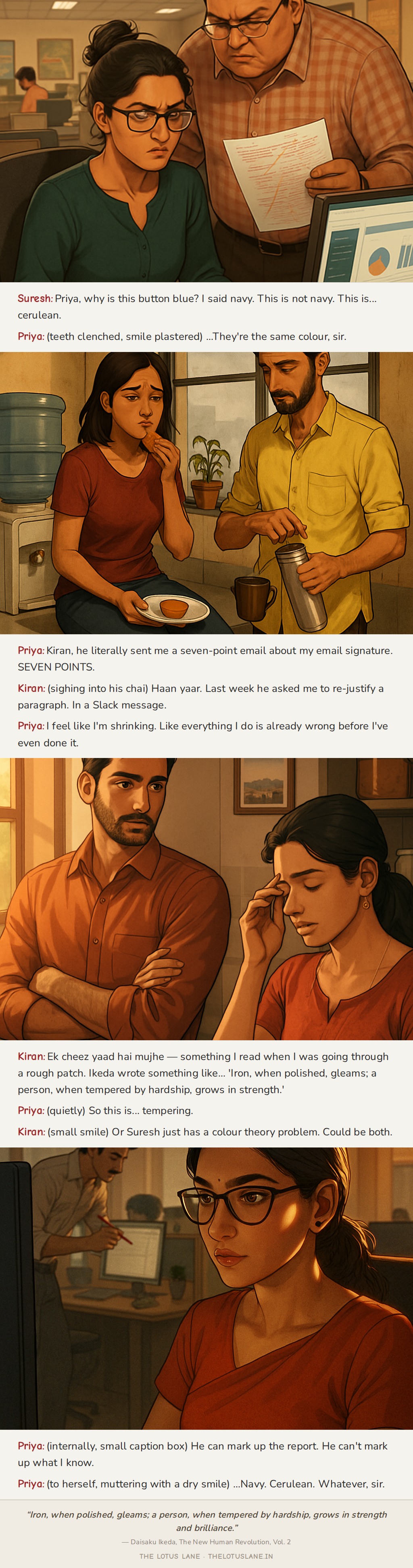
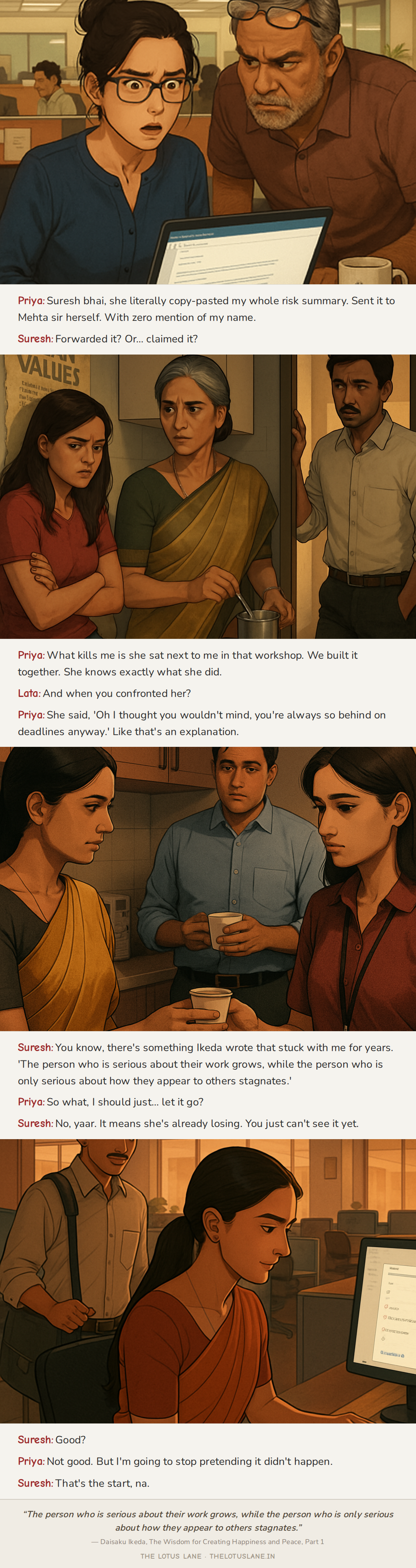
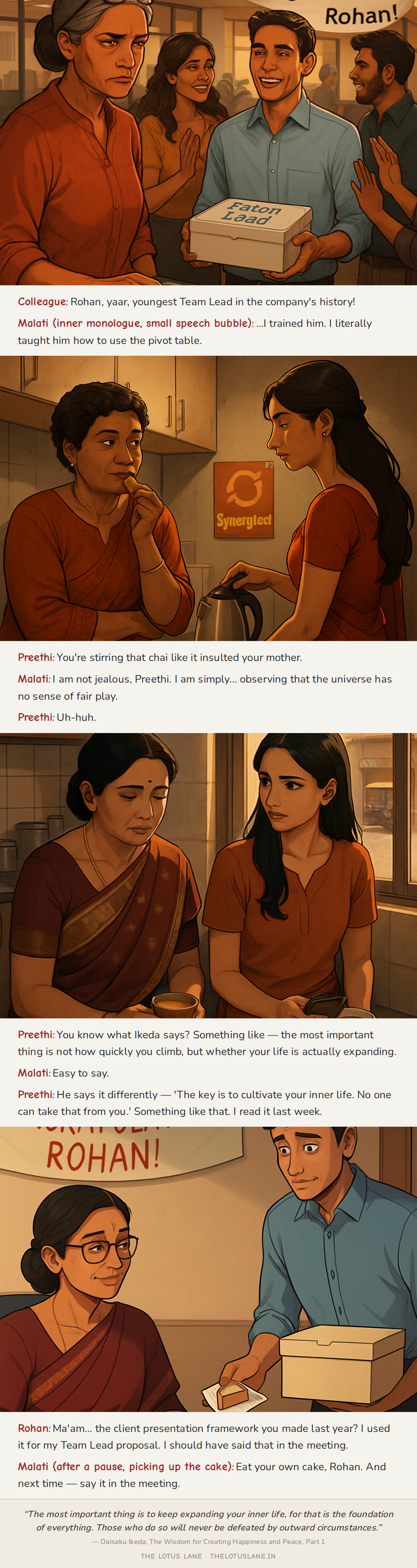
You know that feeling when your alarm goes off on a Monday morning and your stomach drops before you're even fully awake? Not because of the work itself - but because of them. The boss who takes credit for everything you do. The colleague who smiles to your face and then picks you apart in the meeting you weren't invited to. The culture where cruelty gets dressed up as "high standards" and exhaustion gets mistaken for dedication. You lie there staring at the ceiling, running through scenarios, rehearsing conversations that will never go the way you plan. And then you get up, get dressed, and go back in anyway.
If that's you right now - if you're reading this at some ungodly hour because you couldn't sleep and you just needed someone to tell you that you're not crazy - then this is for you. Not a lecture. Not a listicle about "10 ways to manifest workplace joy." Just some honest thinking about how to stay sane and intact when the place you spend most of your waking hours is genuinely making you miserable.
First: What You're Feeling Is Real
Before anything else, let's just say it plainly: toxic workplaces cause real damage. Not just bad moods. Real, physical, psychological damage. Chronic stress from a hostile work environment can affect your sleep, your immune system, your sense of who you are. When you're constantly second-guessed, belittled, or kept in a state of low-grade fear, your nervous system responds as if you're in actual danger - because to some part of your brain, you are.
So if you've been feeling off lately - snapping at people you love, lying awake replaying that comment your manager made, losing interest in things that used to matter to you - that's not weakness. That's your body telling you something true. The first step is to believe it.
The Trap of "Just Quitting"
Yes, in a perfect world you would walk in tomorrow, say something memorable, and leave. But most of us can't do that. There are bills. There's a mortgage or rent. There are people depending on you. There might be a visa tied to the job, or a project you can't abandon, or simply nowhere else lined up yet. And the advice to "just leave if it's that bad" - as well-meaning as it sometimes is - can feel like someone telling a person with a broken leg to just walk it off.
So the real question isn't always how do I escape? It's: how do I survive this without losing myself in the process?
Draw a Line Around Your Inner Life
Here's something that sounds simple but is genuinely hard to do: stop letting the toxic environment colonize your mind when you're not in it. The office has your hours. It does not get your evenings, your weekends, your 2am thoughts, your sense of self-worth.
This means creating a deliberate boundary - not a passive one. It means deciding, actively, that when you leave the building (or close the laptop), you are not available to be consumed by it. That might look like a walk you take every day after work that belongs only to you. A rule that you don't check work messages after a certain hour. A conversation you have with yourself: I am not my job title. I am not their opinion of me.
This isn't denial. You're not pretending everything is fine. You're just refusing to let their dysfunction rent space in your head for free.
Document Everything - Quietly
This is the practical part that people often skip because it feels paranoid. It isn't. If you are being treated badly - if there's harassment, gaslighting, or any kind of systematic undermining - keep a record. Dates, times, what was said, who was present. Keep it somewhere personal, not on a work device.
This does two things. First, it protects you if things ever escalate to HR or legal territory. Second, and less obviously, it protects your sense of reality. Toxic environments often work by making you doubt your own perception. ("You're too sensitive." "That's not what happened." "Everyone else is fine.") Having a written record is an anchor. It tells you: no, this is real, this happened, here it is in black and white.
Find One Person - Just One
You don't need to build a coalition or launch a workplace revolution (though more on that in a moment). You just need one person - a colleague, a friend outside work, a family member, a therapist if you have access - who sees what you see. Someone you can be honest with. Toxic workplaces often isolate people, make them feel like they're the only one struggling, the only one who sees the problem. Find someone to break that isolation with. It matters more than you think.
The Fear That Keeps You Frozen
One of the hardest things about a toxic workplace is that it often creates a very specific kind of fear: the fear of speaking up, pushing back, or even just drawing a boundary. What will they do? Will I be sidelined? Will I lose my job? Will it get worse?
That fear is legitimate. But fear doesn't have to mean paralysis. As one philosopher wrote, drawing on a lifetime of teaching about human struggle: "Courage is not the absence of fear. Courage is feeling fear, recognizing fear, and still taking action."
Taking action doesn't have to mean a dramatic confrontation. It might mean simply saying "I'd like that in writing" the next time something feels off. It might mean choosing not to laugh at a comment that isn't funny. Small acts of integrity, practiced repeatedly, are how you keep your self-respect intact - and how you quietly signal, to yourself most of all, that you haven't disappeared.
The Long Game: Don't Let It Rewrite You
Here's something insidious about spending extended time in a toxic environment: it can start to change how you see yourself. You begin to internalize the criticism. You start to believe the narrative they've constructed about you. You get smaller. Quieter. More careful. And eventually you can't quite remember who you were before you started working there.
Watch for this. Watch for the moments when you catch yourself saying "I'm just not very good at..." or "I guess I'm too sensitive" - and ask yourself: did I always think that, or did I learn it here? Because there's a real difference between honest self-reflection and absorbing someone else's cruelty as if it were truth.
Whatever it takes - old journals, old friends, old hobbies, old photographs - stay in contact with the person you are outside that place. They're still there.
Endurance Is Not the Same as Defeat
There's a kind of shame that can come with staying in a bad situation. A voice that says: if you were stronger, you'd have left by now. If you were smarter, you'd have fixed it. But endurance - conscious, deliberate, dignified endurance while you work toward something better - is not weakness. It's one of the harder things a person can do.
There's a line that's stayed with me, from the same tradition of thought: "The last five minutes of endurance - that is what decides victory or defeat. Never give up in the crucial moment." It's talking about something bigger than any one situation, but the truth in it applies here: the fact that you're still going, still trying to think clearly, still looking for ways forward at 2am - that counts for something.
And Yes: Keep Working Toward the Exit
Surviving a toxic workplace is not the same as accepting it forever. Endurance is a strategy, not a life sentence. While you're working through the day-to-day, keep one part of your mind on the longer term. Update your resume - even if it feels premature. Have the coffee with the former colleague who mentioned an opening. Take the online course. Build the skill. Stay connected to the world outside the building.
Because circumstances do change. Opportunities do appear. And when yours comes, you want to be ready - not so depleted that you can't see it, not so ground down that you've stopped believing you deserve better.
An ancient philosophical text puts it simply: "Fall down seven times, stand up eight." Not because falling doesn't hurt. It does. But because that eight is always available to you. That next stand-up is always possible.
You're Not Alone in This
There's something else worth saying. The way you handle this - how you respond to being treated badly, how you stay human in a dehumanizing environment, how you protect your integrity when it would be easier not to - that ripples outward in ways you can't always see. The colleague who watches you refuse to go along with something unfair. The younger person who notices that you said something true in a room where everyone else went quiet. One person deciding to stay decent, stay honest, stay themselves - it matters more than it looks like it does.
Right now, though, the person it needs to matter for most is you. You reached out tonight looking for help. That already says something about you - that even in this, you haven't given up on finding a better way through.
That's enough. Keep going.