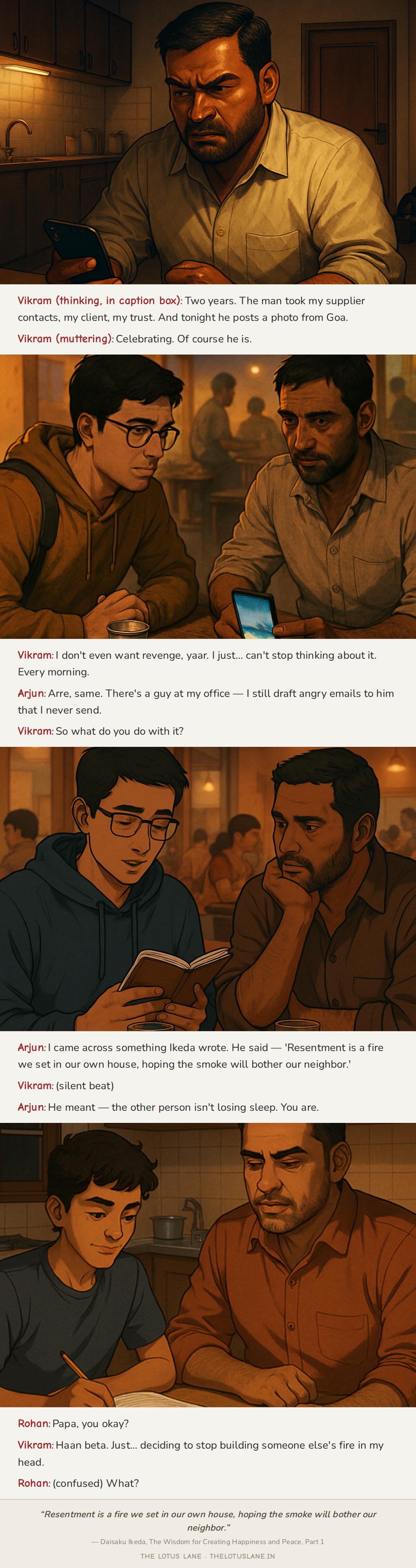
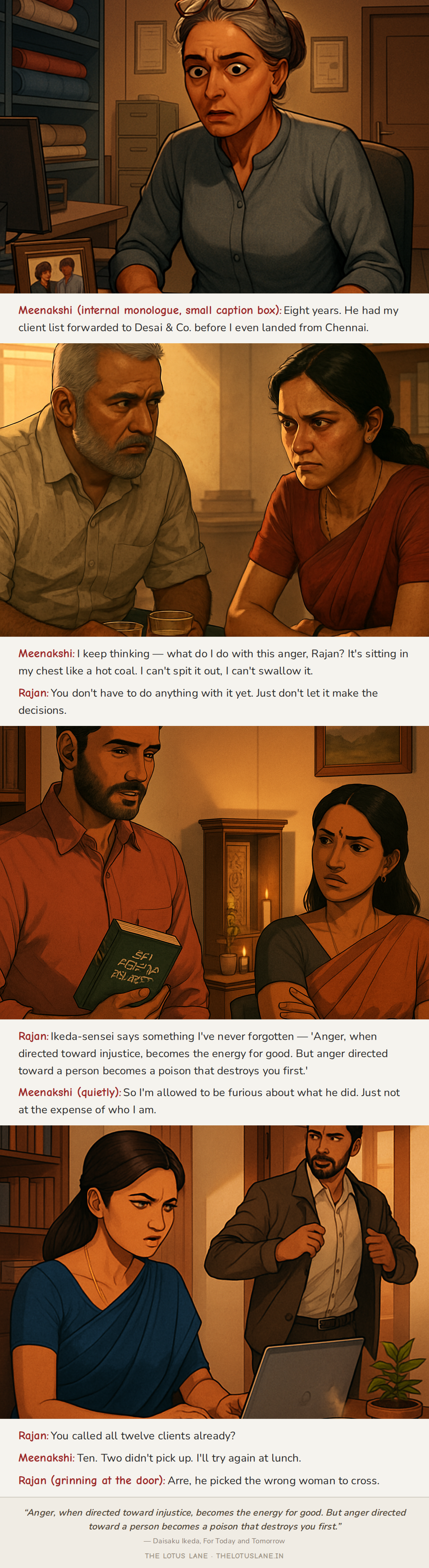
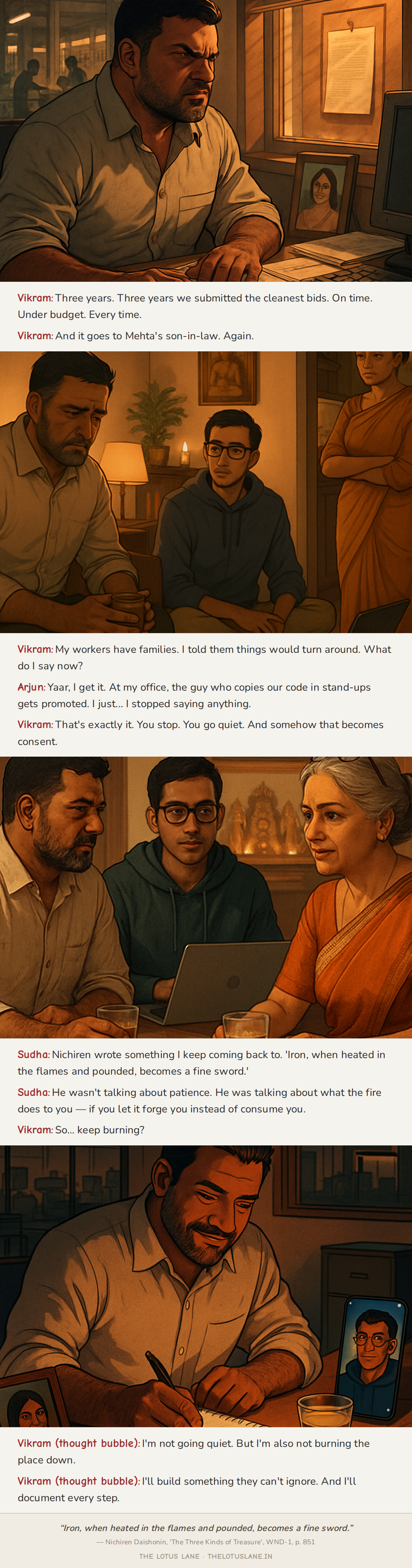
You know that feeling when someone says the wrong thing - maybe it's a small thing, maybe it's something they've said a hundred times before - and suddenly you're not just annoyed. You're gone. Something floods in, hot and fast, and before you even know what's happening, you've said something sharp. Or you've slammed a door. Or you've gone completely cold and silent in a way that's somehow worse than shouting.
And then, maybe ten minutes later, maybe the next morning, you're sitting with the aftermath. The person you snapped at is someone you love. The thing that triggered it wasn't really the thing. And you're left wondering - what is wrong with me? Why do I keep doing this?
If you're reading this at 2am because anger did something tonight that you can't undo, first: you're not broken. You're human. And this is worth understanding.
Anger Is Never Really About the Surface
Here's something that took philosophers centuries to articulate clearly, but that you probably already know in your gut: the thing that made you explode is almost never the actual problem. The dishes left in the sink. The offhand comment. The person who cut you off in traffic. These are sparks landing on something that was already burning underneath.
Anger, at its core, is usually a signal. It's pointing at something - exhaustion, fear, grief, a boundary that's been crossed too many times, a need that's gone unmet so long you've stopped being able to name it. The rage doesn't lie, exactly. It just speaks in the wrong language.
When anger takes over completely - when it moves faster than your ability to think - it usually means the pressure has been building for a while. Not hours. Often weeks, months, years. You weren't just angry at that person tonight. You were angry at everything that's been quietly accumulating under the surface.
Why You Snap at the People Closest to You
There's a painful irony here that's worth naming directly: we tend to lose our tempers most with the people we feel safest with. Not because we don't love them. Because we do. They're the ones we don't have to perform for. The mask comes off, and sometimes what's underneath isn't pretty.
At work, or with acquaintances, we hold it together. We manage. We speak carefully. But at home - with a partner, a parent, a close friend - the effort of containment runs out. And the explosion happens there, in the space that was supposed to be safe.
Understanding this doesn't excuse the harm it causes. But it might change how you look at yourself. You're not a monster. You're someone who's been holding too much for too long, and the container finally cracked.
What Happens in Your Body
When anger floods you, your body is doing something very specific. Your nervous system has clocked a threat - real or perceived - and activated the same biological alarm system your ancestors used to survive predators. Blood moves to your muscles. Your thinking brain gets partially bypassed. You're primed to fight, flee, or freeze.
This is why reasoning with yourself in the middle of rage almost never works. You're not in your full mind. The part of you that considers consequences, that remembers you love this person, that thinks before it speaks - that part has stepped back from the wheel.
This isn't an excuse. It's information. Because once you understand what's happening physically, you have a point of intervention. You can learn to notice the early signs before the flood takes over - the tightening in your chest, the heat rising in your face, the slight narrowing of focus. Those are your warning signals. That's your window.
What Ancient Wisdom Actually Says About This
There's a line that has stayed with me, from a collection of philosophical writings on what it means to truly help another person. It goes like this: "Compassion is not about feeling pity for others. It is about sharing their suffering and working together to overcome it." When I first read it, I thought it was about how we treat other people. But lately, I think it also applies to how we treat ourselves.
Most of us, when we've acted badly in anger, swing between two useless extremes: either we justify it ("they deserved it") or we punish ourselves for it ("I'm a terrible person"). Neither of these moves anything forward. Real compassion - including toward yourself - means looking honestly at the suffering underneath the anger, not flinching from it, and then actually doing something about it. Together, if possible. Alone, if necessary. But not in the same pattern, over and over, forever.
Another line, from the same tradition of thinking, puts it this way: "A single warm word can give someone the courage to go on living. Never underestimate the power of your compassion." That applies in both directions. The word you say in anger can do real damage. But a single honest, warm word afterward - "I'm sorry. I wasn't angry at you. Let me try to explain what's actually going on" - can do something extraordinary. It can open a door that the anger slammed shut.
Some Things That Actually Help
Philosophy is useful, but you also need something to do. Here are a few things that genuinely work - not magic fixes, but honest tools:
Learn your early warning signs. Anger doesn't usually arrive without notice. It builds. Start paying attention to what happens in your body in the ten minutes before you lose it. Cold feet? Clenched jaw? A specific thought pattern? Once you know your personal warning signs, you have more time than you think.
Buy yourself two minutes. When you feel the flood coming, the single most useful thing you can do is leave the room. Not dramatically. Just - "I need a minute." Go to the bathroom. Step outside. Walk to a different part of the house. Two minutes of physical distance can be enough for your nervous system to begin returning to baseline. You don't need to resolve anything in those two minutes. You just need to not say the thing you can't take back.
Get curious about what's underneath. After things have calmed down - not during - ask yourself what was really going on. Were you scared? Exhausted? Feeling unseen or unheard in some ongoing way? Angry people are often deeply hurt people. The hurt is usually worth looking at directly.
Say the true thing, not the surface thing. Instead of "you never listen to me," try "I feel like I don't matter to you when this happens, and that scares me." It's harder. It's also far more likely to actually reach someone.
Talk to someone. Not because something is catastrophically wrong, but because carrying this alone is part of what makes the pressure build. A friend who won't judge you, or a therapist, or even a journal - the point is to get it out of your body and into a form you can look at.
You Are Not Stuck Like This
There's a way of thinking about human beings - woven through centuries of philosophical thought - that insists people are not fixed. That we are capable of genuine change, not through willpower alone, but through understanding ourselves more clearly over time. One writer in this tradition put it plainly: the goal of real learning isn't to fill a person with information, it's to light something in them. A kind of inner fire that helps them find their way through their own life with more wisdom.
That fire can apply to this. You can understand your anger well enough that it stops running you. Not by suppressing it, not by pretending it isn't there, but by getting underneath it - slowly, honestly, without too much self-hatred.
The fact that you're asking these questions at 2am means you care. About the people you hurt. About who you want to be. That's not nothing. That's actually quite a lot to work with.
Tomorrow, if you can, say the thing you couldn't say tonight. Not the surface thing. The true thing. And if tonight went badly - if words came out that you wish hadn't - know that repair is possible. Relationships are more resilient than we think, when we show up honestly.
You don't have to get this perfect. You just have to keep trying to understand yourself a little better than you did before. That's enough. That's genuinely enough.