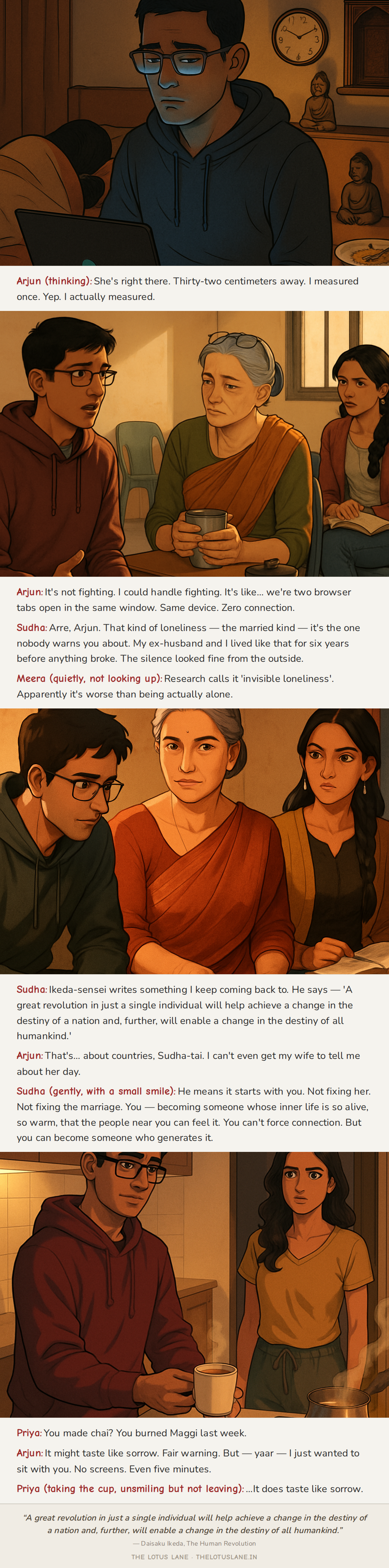
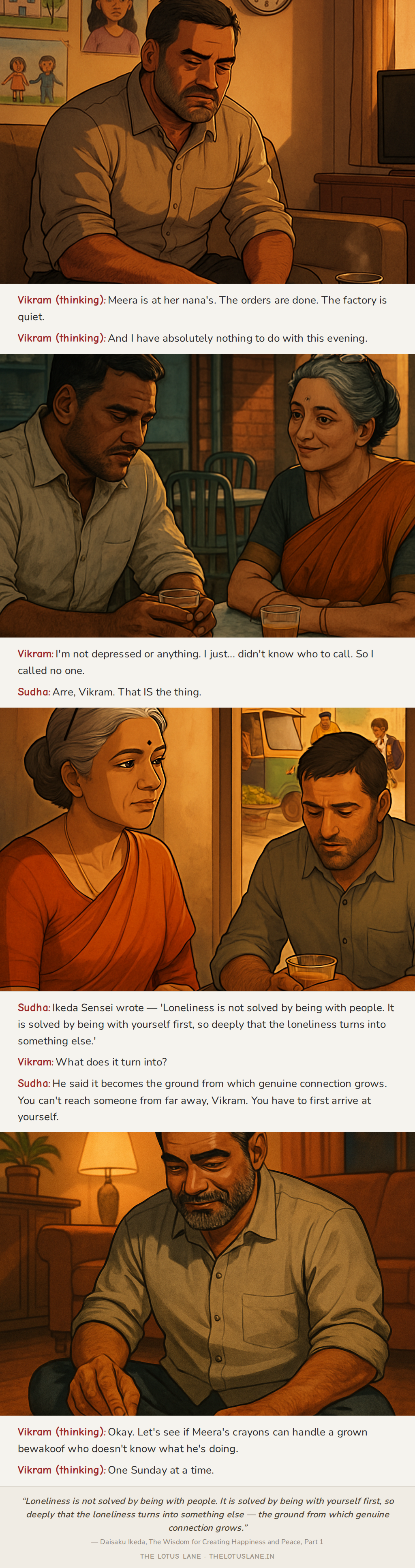
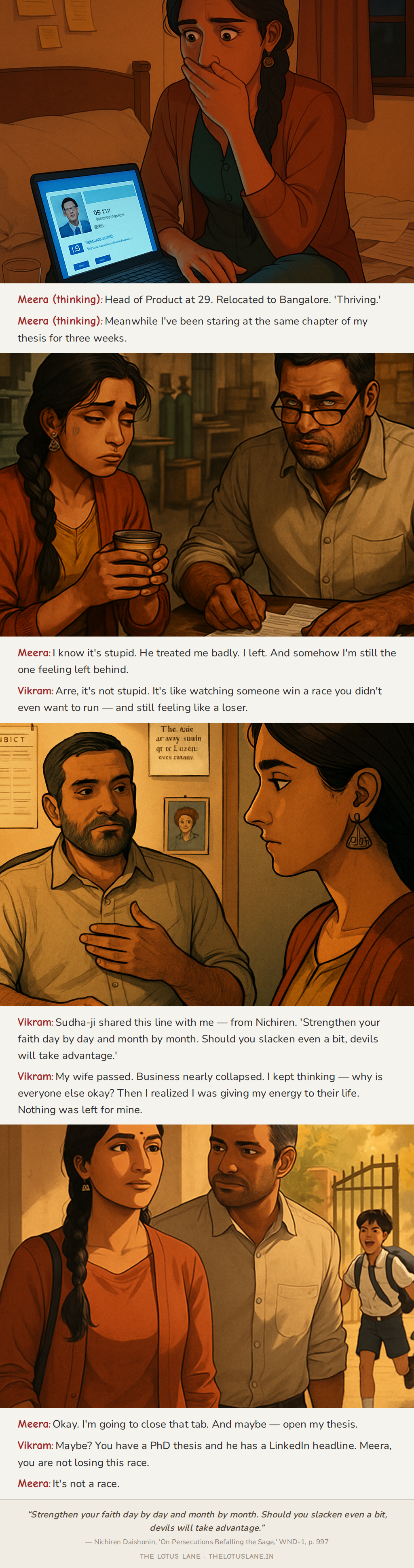
You know that feeling when you're lying in bed next to someone you used to know everything about, and you realize you have absolutely nothing to say to them? Not because you're tired. Not because it's late. But because somewhere along the way, the thread between you two just... frayed. And now you're both staring at the ceiling in the dark, and the silence isn't comfortable anymore. It's just silence.
If that's where you are right now - or somewhere close to it - this is for you. Not the version of you that has it together. The version that's up at 2am, quietly falling apart, wondering how two people who once couldn't stop talking to each other ended up here.
First, let's just be honest: this is one of the most painful things a human being can go through. Losing someone you still technically have. Grieving a relationship that isn't even over yet. There's no clean word for it. It just hurts in a dull, constant way that makes ordinary life feel slightly unreal.
The Distance Doesn't Happen All at Once
Most relationships don't fall apart with a dramatic fight or a single breaking point. They fall apart in small increments. A conversation you chose not to have. A disappointment you swallowed instead of shared. A night where you both retreated into your phones and didn't think much of it. Then another night. Then a week of those nights.
By the time you notice something is seriously wrong, there's often so much distance between you that it's hard to even remember what it felt like to be close. You might find yourself going through the motions - dinner, logistics, maybe even sex - while feeling completely alone. That particular loneliness, the kind that happens inside a relationship, is its own specific kind of terrible.
And what makes it worse is that nobody around you necessarily knows. From the outside, you're still a couple. You still show up to things together. You probably still laugh at the right moments. But inside, you know. And they probably know too. You're just both pretending, because saying it out loud makes it real.
What You're Actually Afraid Of
Here's something worth sitting with: when a relationship starts to fall apart, most people don't just fear losing their partner. They fear what that loss says about them. About the time invested. About the version of the future they had quietly planned. About whether they're capable of being truly loved at all.
Those fears are real. But they're also worth separating from the actual question in front of you - which is: what do you do right now, tonight, when things feel this broken?
Because "what do I do?" is a different question from "what does this mean about me?" And you deserve to answer the first one before you spiral into the second.
The Hardest Thing: Actually Talking
You probably already know, somewhere in your gut, that the distance between you and your partner exists in large part because real conversation stopped. Not the "how was your day" kind. The kind where you actually say what you mean. Where you admit what you need. Where you risk saying something true instead of something safe.
A philosopher whose writings have been studied across generations once put it plainly: "Dialogue is the most fundamental and effective means for building peace. It is the very foundation of civilization." That might sound grand - civilization, peace - but it applies to two people sitting across from each other at a kitchen table, too. The same principle holds. When communication breaks down, everything else breaks down with it. And when you find a way back to honest conversation, even one real conversation, something shifts.
This doesn't mean you have to have The Big Talk tonight. In fact, trying to resolve everything in one exhausted, emotionally loaded conversation is usually a recipe for saying things you'll regret. But it might mean deciding, consciously, that you want to try talking again. Not arguing. Talking. There's a difference.
One practical thing: pick a time when neither of you is already stressed or depleted. Not right after work. Not when someone's hungry. Sounds almost absurdly simple, but timing matters more than most people realize. And start small. Not with "we need to talk about us" - which puts the other person immediately on the defensive - but with something real. Something honest. Even something like: "I feel like we've been far apart lately. I miss you." That's not an attack. It's an opening.
When You're the One Carrying Everything
Sometimes in a relationship that's struggling, one person is doing almost all the emotional heavy lifting. They're the one trying to fix things, the one bringing it up, the one reading articles at 2am trying to figure out what to do. And that is exhausting in a way that's hard to describe - because you're not just tired, you're also resentful, and then you feel guilty for the resentment, and the whole thing becomes this complicated knot.
Here's something that might reframe that, even slightly. One philosophical tradition puts it this way: "Compassion is not about feeling pity for others. It is about sharing their suffering and working together to overcome it." The key phrase there is together. Compassion, real compassion, isn't supposed to be one-directional. If you are pouring everything you have into someone who isn't meeting you halfway, that's worth naming - both to yourself and, when you're ready, to them.
Being caring doesn't mean being endlessly self-sacrificing. You are also a person who deserves to be seen, to be considered, to have their pain acknowledged. If you've been putting that aside because you're focused on saving the relationship, it's worth asking: are you saving the relationship, or are you just keeping the peace? Those are not the same thing.
Some Honest, Practical Things You Can Do
Write it down first. Before any hard conversation, write down what you actually want to say. Not to read from - just to get it out of your head and onto paper so you can see it clearly. You'll often find that what you thought you were upset about isn't really the main thing. The main thing is usually something smaller and more vulnerable.
Ask one real question. Not "why do you never listen to me?" but something genuinely curious - "What do you feel like we're missing right now?" or "Is there something you've been wanting to tell me but haven't?" People open up when they feel asked, not interrogated.
Consider whether you've said the thing you haven't said. Most struggling relationships have at least one unsaid thing sitting in the middle of them like a piece of furniture everyone walks around. You know what yours is. So do they, probably. Sometimes the only way forward is to finally say it.
Give it more than one conversation. If you do manage to have an honest talk and it doesn't go perfectly, that doesn't mean it failed. Rebuilding takes time. One conversation doesn't fix years. But one real conversation can be the first step toward actually trying.
Get outside help if you need it. Couples counseling still carries a strange stigma, like admitting failure. It isn't. It's two people deciding they care enough to bring in someone who knows how to help. That takes courage, not weakness.
About Compassion - For Both of You
The same philosophical tradition that spoke about dialogue also said this: "True compassion is not soft or weak. It takes great strength to truly care about others, to shoulder their pain." That's worth holding onto - because sometimes staying in a hard conversation, choosing to try again when everything in you wants to shut down, choosing to care when you're running low on the capacity to care - that's not weakness. That's one of the stronger things a person can do.
And it applies to how you treat yourself, too. You're going through something genuinely difficult. The fact that you're still trying - that you're up at 2am looking for answers instead of giving up - says something real about who you are.
If This Is the End
Not every relationship can or should be saved. That's true, and it would be dishonest to pretend otherwise. Some connections run their course. Some damage is real and not repairable. If you find yourself moving toward an ending, that doesn't mean you failed - it means you're being honest about something that took courage to admit.
But you don't have to decide that tonight. Tonight, you just have to get through tonight.
And maybe, if there's still something worth reaching for - reach for it. Not perfectly. Not with all the right words. Just honestly. That's usually enough to start.
Whatever happens, you are not alone in this. More people than you can imagine are lying awake right now with the same ache you're carrying. The fact that you still care enough to look for a way through - that matters. Hold onto that part of yourself. It's the best part.