You know that feeling when you wake up at 3am and for exactly one second, everything is fine? And then it hits you. The bed feels wrong. The house sounds wrong. And the life you spent years building - the shared passwords, the inside jokes, the habit of saving the last bite for them - is coming apart at the seams.
If that's where you are right now, this is for you.
Not the you that has to hold it together at work tomorrow. Not the you that tells people "we just grew apart" because the real answer is too heavy to carry in casual conversation. This is for the you that's up at 2am, phone in hand, searching for something - anything - that makes this feel survivable.
It is survivable. But let's not pretend that means it's easy, or quick, or that you'll feel better after reading an article. You probably won't. What you might feel is a little less alone. And right now, that's worth something.
The Thing Nobody Warns You About
Everyone warns you about the sadness. Nobody warns you about the shame.
There's a particular kind of shame that comes with a marriage ending - this quiet, crushing sense that you failed at the thing you were supposed to be best at. That you picked wrong, or loved wrong, or that there's something fundamentally broken in you that caused this. Society doesn't help. There's still, even now, a way that divorce gets treated as a personal moral failure rather than what it actually is: two human beings who couldn't make it work.
And the grief is strange, too. It doesn't behave like other griefs. You're not mourning someone who died. You're mourning someone who's still alive, who might be angry with you, who might be moving on faster than you are. You're grieving a future that won't happen - the holidays, the anniversaries, the growing old together you had planned. That kind of grief doesn't have a clear ritual. Nobody brings you casseroles for a divorce.
So you carry it quietly, often alone, often at night.
What the Hardest Season Actually Means
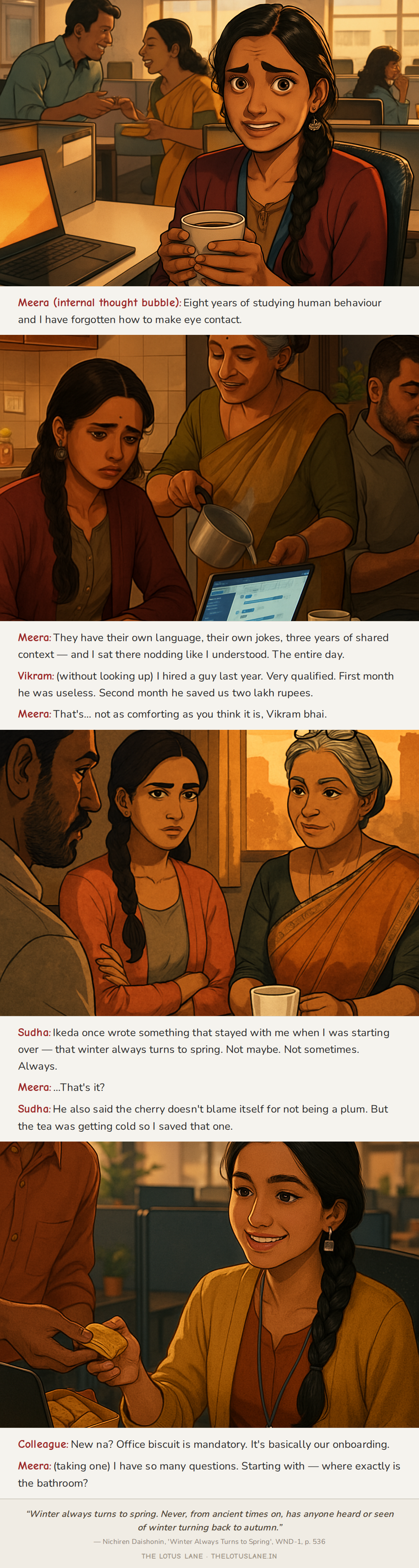
There's a line from a 13th-century collection of letters that I keep coming back to when things feel irreversible. It says: "Winter always turns to spring. Never, from ancient times on, has anyone heard or seen of winter turning back to autumn."
Read that again slowly.
It's not saying winter is short, or painless, or that you should be grateful for the cold. It's saying something more stubborn than that. It's saying the direction only goes one way. You are not going backwards. You cannot go backwards. Even when it feels like you're losing everything, time is still moving forward, and forward is the only place spring exists.
This isn't optimism. Optimism is cheerful and easy and usually unhelpful when you're in real pain. This is more like geology. It's just how things work. The season you're in right now - as brutal as it is - is not the final season.
The Practical Stuff: What to Actually Do
Philosophy only goes so far. Here are some real things that help, drawn from what people who've been through this actually report:
Stop making big decisions for now. If you can avoid it, don't quit your job, don't move to another city, don't start a new relationship, don't dramatically cut off people you love - for at least six months. Your nervous system is in crisis mode. The decisions you make in crisis mode are rarely the ones you'd make otherwise. Give yourself a buffer.
Find one person to be completely honest with. Not five people. Not social media. One person who can hear the ugly version - the part where you're angry, or embarrassed, or where you did something you're not proud of. Carrying something alone makes it heavier. There's real wisdom in the idea that a good friend is someone who "speaks honestly with you, challenges you to grow, and stands by you in your darkest hour." Find that person. Let them in. It doesn't make you weak. It makes you human.
Get your paperwork in order, even when you don't want to. The practical side of ending a marriage - the legal documents, the finances, the shared accounts - can feel unbearable when you're emotional. Do it anyway, a little at a time. Make a list. Tackle one item per week if that's all you can manage. Leaving it undone just means the anxiety compounds.
Create a tiny daily anchor. When your entire life structure has shifted, structure itself becomes medicine. It doesn't have to be big. A walk at the same time every morning. Tea before bed. Twenty minutes of something - reading, stretching, anything that's just yours. Grief can make the days feel formless and strange. A small anchor gives the day a shape.
Let yourself grieve specifically. Not just "I miss my marriage." Grieve the specific things. The Sunday mornings. The way they laughed at a particular kind of joke. The person you were when you were with them. The more specific you can be, the more real the grief becomes - and real grief, felt properly, actually moves through you. Vague, suppressed grief just sits there and gets heavier.
About Starting Over
Somewhere in the middle of all this, you'll face the terrifying question of who you are now. The roles you held in the marriage - partner, spouse, maybe parent in a different configuration than before - those were part of how you understood yourself. And when those change, there's a real identity crisis underneath the heartbreak.
That crisis is not a sign that you're broken. It's a sign that you were genuinely invested. You can't lose what you didn't truly have.
The rebuilding is slow. It happens in small moments - a laugh you didn't expect, an afternoon that felt almost okay, a realization that you made a decision entirely on your own and it worked out fine. You won't notice it happening until you look back from a few months away and see that something has shifted.
One writer on human struggle put it simply: "As long as we have hope, we have direction, the energy to move, and the map to move by." Not happiness. Not certainty. Just hope. And hope, the same tradition argues, isn't something you wait to feel - it's something you choose. You decide, even when you don't fully believe it yet, that there is a forward. And then you take the next small step in that direction.
The People Around You
One of the cruelest parts of a marriage ending is that it often reshapes your entire social world. Mutual friends who don't know what to do. Family members who pick sides. People who disappear because your situation makes them uncomfortable about their own.
Let them go. You'll find out who your real people are, and that information - as painful as it comes - is actually valuable. The people who show up now, who don't need you to perform being okay, who bring food anyway even without a clear ritual for it - those are the ones worth building the next chapter around.
Friendships, it turns out, are not secondary things. They're not what's left over after the "important" relationships. One book of guidance I've read says it directly: "Friendship is the most beautiful treasure in life. Cherish your friends. Nurture your friendships. They are the foundation of a happy life." Not a supplement. A foundation. The marriages that survive, and the individuals who survive when marriages don't, are almost always surrounded by people who genuinely show up.
Invest in those people right now. Call the one who actually asks how you are. Accept help when it's offered. Let people bring you that metaphorical casserole.
One Last Thing
You searched for this at 2am because something in you is still looking for a way through. That instinct - to look, to seek, to refuse to just lie there and drown - matters. It doesn't mean you're fine. It means you're still trying.
The life you had is ending. That is real, and it is hard, and you are allowed to feel the full weight of it. But it is not the last life you'll have. Not even close.
The season you're in right now is winter. Winter is supposed to be hard. And winter, without exception, turns.
Be gentle with yourself tonight. Tomorrow you can do the next small thing. Tonight, it's enough to have made it to morning.