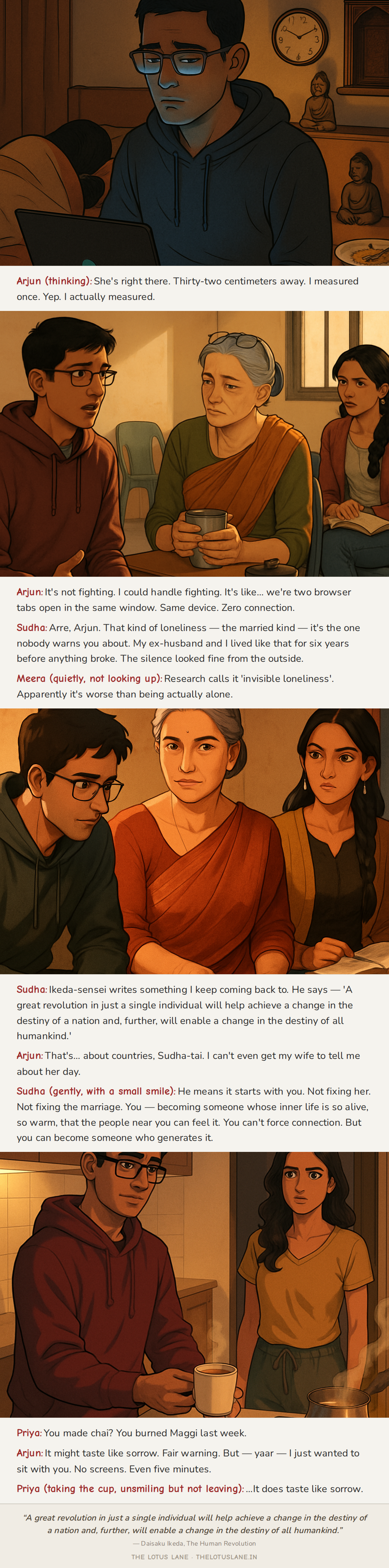
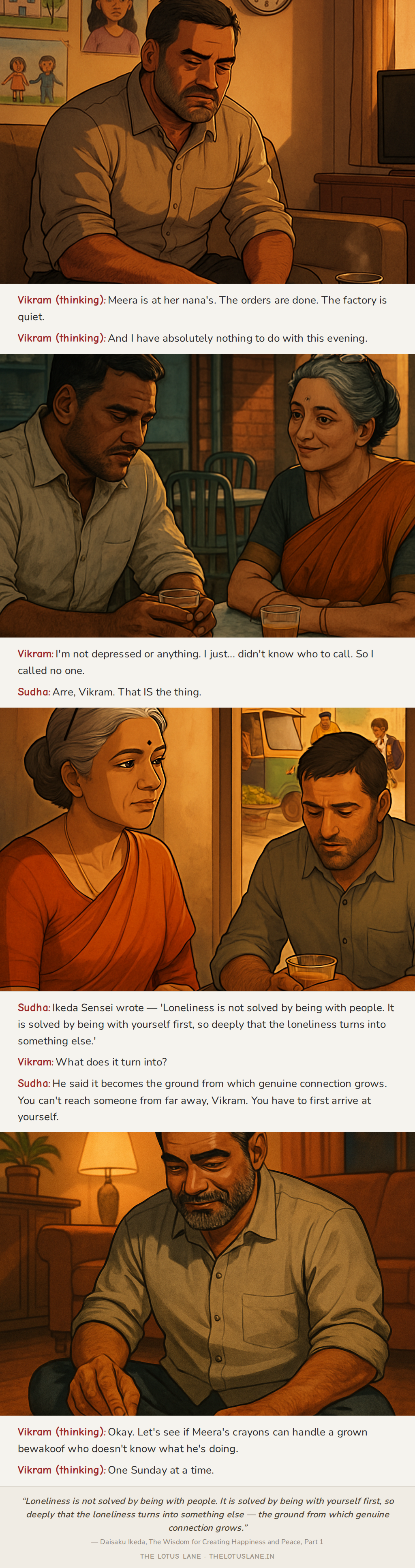
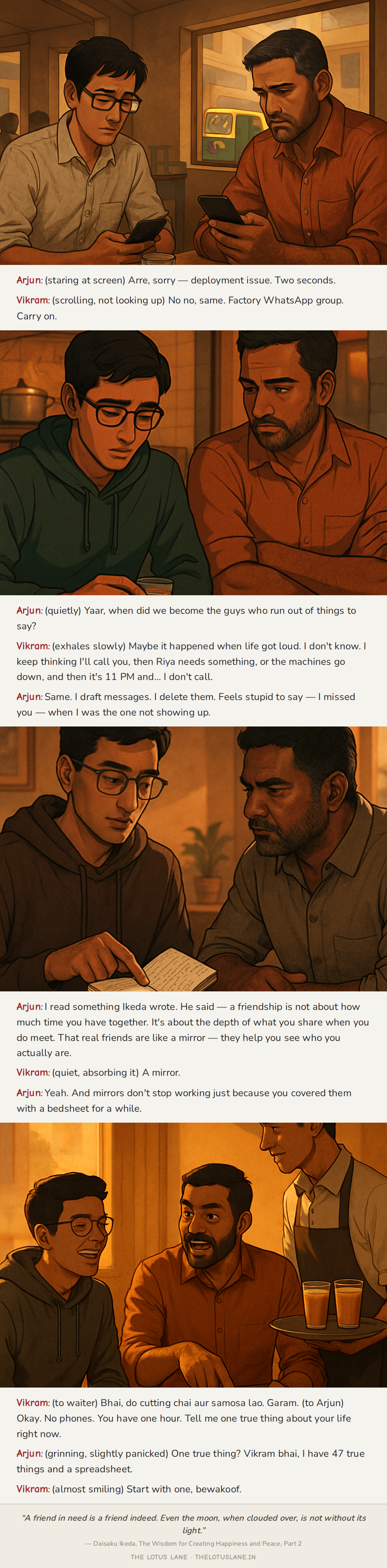
You know that feeling when you're sitting in a room full of people - maybe it's a party, maybe it's your own dinner table, maybe it's a group chat blowing up on your phone - and something inside you goes very, very quiet? Not peaceful quiet. The other kind. The kind that makes you wonder if you're somehow fundamentally different from everyone else. If there's a conversation happening beneath the surface that everyone else got the script for, and you're just standing there, nodding, performing "person who is fine."
If you're reading this at 2am, you're probably not fine. And that's okay. That's actually the most honest thing about tonight.
This particular kind of loneliness - the kind that lives inside connection, that hides in the middle of relationships - is one of the least talked about kinds of suffering. Because it comes with shame attached. At least if you're physically isolated, the math makes sense. But surrounded by people who love you, or at least like you, and still feeling like you're watching your own life through glass? That's harder to explain. Harder to admit. So most people don't. They just keep showing up, keep performing, and lie in bed at 3am feeling like something is wrong with them specifically.
Nothing is wrong with you specifically. But something might be worth looking at honestly.
Why Being Around People Doesn't Always Mean Being With People
There's a difference between proximity and presence. You can share a bed with someone for ten years and never really be seen by them. You can have two hundred people show up to your birthday and feel completely invisible. The body can be in the room while the self waits, alone, outside the door.
This happens for a lot of reasons. Sometimes we've learned - usually a long time ago - that showing the real version of ourselves leads to something bad. Rejection, ridicule, being "too much," being "not enough." So we edit. We show a version of ourselves that we've calculated is safe, acceptable, manageable. And then we feel lonely, because of course we do - the person in the room isn't quite us. The connection happening isn't quite real. We engineered it that way, and it worked, and now we're suffering from our own success.
Sometimes it's simpler than that. Sometimes the people around us are genuinely good people who just don't speak our particular language. The love is real but the understanding is shallow, and both things can be true at once. That's not a betrayal. It's just the specific loneliness of being one kind of person surrounded by another kind, and nobody's fault.
And sometimes - maybe especially in this era - we've gotten very good at being in contact and very bad at being in connection. Messages fly back and forth constantly. Everyone is reachable. Nobody is really there. We've confused availability with intimacy, and somewhere along the way, we got starved while sitting at a full table.
The Thing About Real Connection That Nobody Warns You About
Here's what's uncomfortable: real connection requires risk. It requires showing someone the unedited version and not knowing what they'll do with it. That's terrifying if you've ever been burned by it, and most of us have.
But there's something important buried in that terror. A text from the 13th century - written as a letter of encouragement to someone who was suffering - puts it plainly: "A single warm word can give someone the courage to go on living. Never underestimate the power of your compassion." What strikes me about this line isn't just what it says about giving - it's what it implies about receiving. That warmth, when genuine, has real weight. Real effect. That we are built for it in a way that makes its absence genuinely painful.
In other words: your loneliness isn't a personality defect. It's evidence that you need something real. Something that actually lands. And that's a very human thing to need.
What Doesn't Help (And What Might)
More people doesn't help. More plans, more social media, more keeping busy - none of that addresses the actual thing. You can't solve depth-loneliness with more surface. If anything, it makes the contrast worse.
Here's what sometimes actually helps, in plain terms:
Say one true thing to one person. Not a crisis confession. Not a dramatic unburdening. Just one small true thing you'd normally smooth over. "I've actually been struggling lately" instead of "I'm fine." "I don't really know how I feel about this" instead of the easy answer. See what happens. You don't have to do it with the safest person in your life - sometimes it's easier with someone you're less invested in. A friend you're not trying to impress. Someone who doesn't know your whole history. One true thing is a small act with an unpredictable yield.
Stop performing for a single conversation. Pick one interaction today - one coffee, one phone call - and decide, quietly, to just be exactly where you are. Tired if you're tired. Uncertain if you're uncertain. Not broadcasting it, just not concealing it. Notice if the conversation changes. It often does.
Let someone help you with something small. Loneliness often comes with self-sufficiency as armor. If you never need anything from anyone, you never risk disappointment, but you also never create the kind of mutual reliance that slowly builds real closeness. Ask for something small. Let it be imperfect. Let someone be useful to you.
Look for what you have in common with the person in front of you. Not what you share - interests, background, opinions - but what you both know about being human. Anxiety. The gap between who you present yourself as and who you actually are. The fear of being really known. Most people you know are carrying some version of what you're carrying. Loneliness often shrinks a little when you remember that.
One philosopher wrote something that's stayed with me: "Compassion is not about feeling pity for others. It is about sharing their suffering and working together to overcome it." There's a whole different approach to relationships buried in that sentence. Not fixing. Not performing care. Actually sharing the weight. That's rarer than it sounds, but it's also what most of us are quietly desperate for.
The Part About Patience
This isn't a fast fix. You might try saying one true thing and get an awkward response, and feel worse for a day. You might reach out to someone and have them miss the point entirely. That will happen. It doesn't mean the approach is wrong; it means you're doing something that takes practice and doesn't always land clean.
There's an old saying that has been passed along for centuries in various forms: "Winter always turns to spring. Never, from ancient times on, has anyone heard or seen of winter turning back to autumn." Which is not a cute metaphor about positivity. It's an observation about direction. That no matter how cold and still things are, they're also moving toward something else. That's not a guarantee that spring will be easy, or soon, or what you expected. But the turning is happening whether you can see it or not.
Your loneliness has a direction too. It's not a permanent condition written into who you are. It's a signal pointing at something real that you need, and signals change when you respond to them.
One Last Thing
If you're up late reading this, there's a version of you that reached out - even anonymously, even to a search bar - because part of you hasn't given up on the idea that something could be different. That matters. "As long as we have hope, we have direction, the energy to move, and the map to move by," as someone once wrote. You don't need to know the whole route tonight. You just need enough light for the next small step.
You are not broken for feeling lonely in a crowd. You are not too much, or too sensitive, or fundamentally unlovable. You are someone who wants real contact with other real people, and that has gotten harder for almost everyone, and it's worth working toward anyway.
Close the tab. Drink some water. Try one true thing tomorrow. That's enough for tonight.