You know that feeling when you check your phone for the hundredth time, hoping something has changed? The email is still there. The message still says what it says. The silence on the other end of the line is still silence. And you're lying in bed at 2am, ceiling staring back at you, running the whole thing through your head again - what you said, what you didn't say, what you should have done differently.
That's where you are right now. And before anything else, that's worth naming: rejection hurts. Not in a metaphorical, poetic way. It actually hurts - in your chest, in your stomach, in the specific weight of your shoulders when you walk around the next day pretending to be fine. Science confirms this, but you already knew it. You felt it the moment it happened.
Whether it was a job you really wanted, a person you put your heart out for, a friend group that closed ranks without you, or a door that simply didn't open - the pain is real. And it deserves to be treated as real, not bypassed with a list of silver linings.
First: Stop Trying to Logic Your Way Out of It
The mind, when it's hurting, wants to explain the hurt away. So we make arguments. "They weren't good for me anyway." "That job would have been stressful." "I didn't really want it that much." Sometimes those things are even true. But when we rush to them too fast, we skip a step that actually matters - just letting ourselves feel the thing.
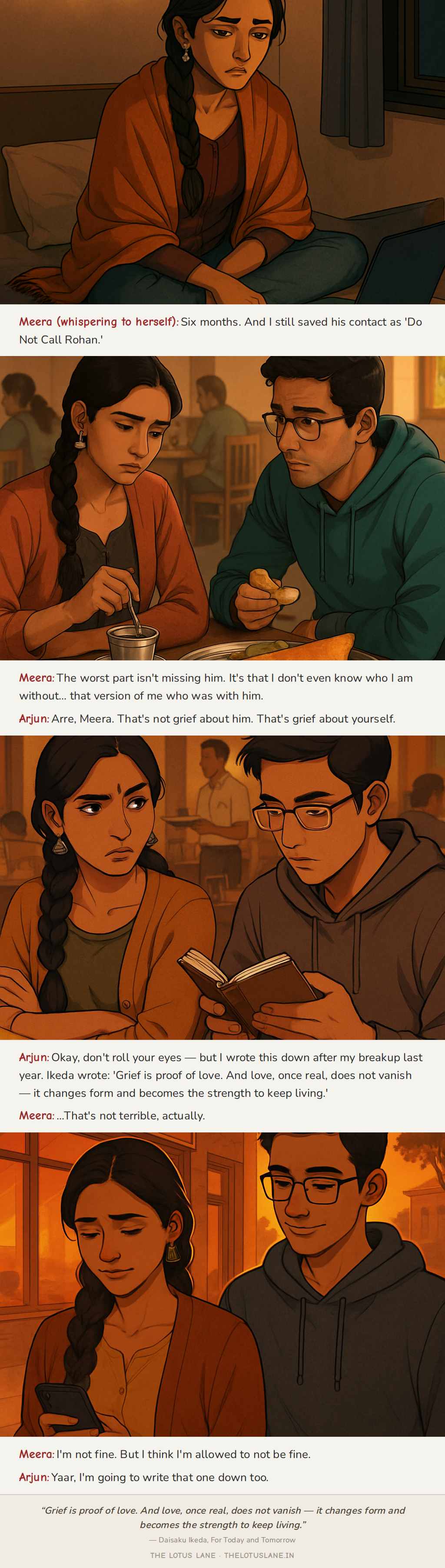
Grief about rejection is not weakness. It's information. It tells you what you cared about. You don't grieve things that didn't matter to you. The ache you're feeling right now is proof that you had genuine hope, that you showed up, that you wanted something real. That's not a character flaw. That's what it looks like to actually live.
Give yourself a day, or two, or a few, to just sit with it. Eat the comfort food. Cancel the plan you don't have energy for. Text the friend who won't make you explain yourself too much. The rush to "bounce back" is one of the crueler expectations we put on ourselves and each other.
The Story You're Telling Yourself Right Now
Here's where it gets tricky. There's the rejection itself - a specific event, a specific moment. And then there's the story your brain starts building around it. And that story, if you let it run unchecked, becomes far more damaging than the rejection was.
The story sounds like: This always happens to me. I'm not good enough. People don't choose me. I'll never find something that works out. That story takes one data point - this rejection, this particular circumstance - and turns it into a verdict about your entire life and worth as a person.
Watch for it. Not to dismiss it or fight it aggressively, but just to notice when it's happening. You can acknowledge the pain without signing off on the whole narrative. "This rejection hurt" is true. "I am someone who will always be rejected" is a story, not a fact.
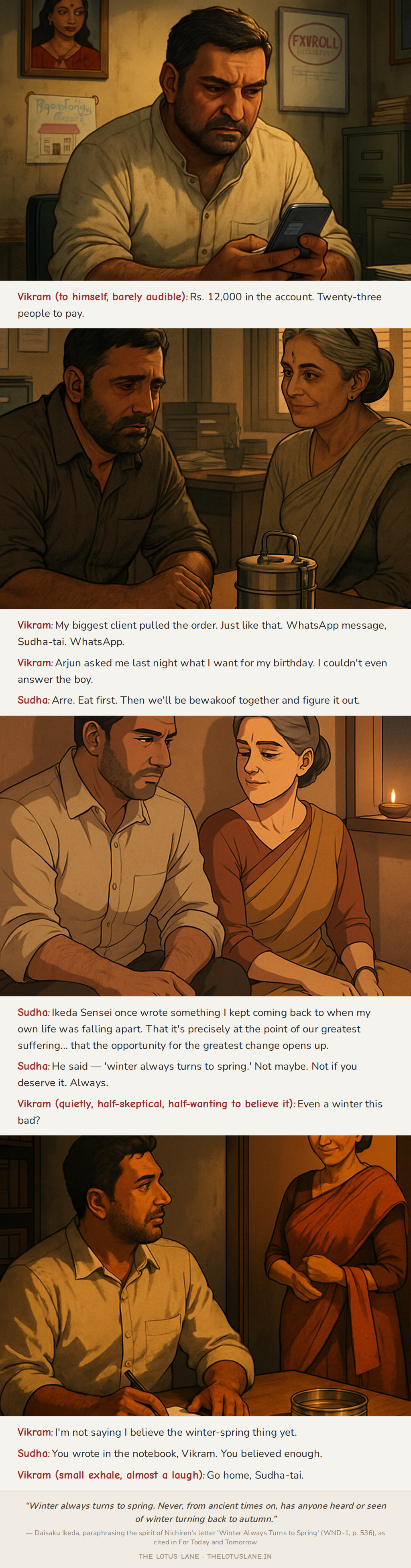
A letter written in 13th-century Japan - in circumstances far harder than most of us will ever face - contains a line that has stayed with people for eight hundred years: "Winter always turns to spring. Never, from ancient times on, has anyone heard or seen of winter turning back to autumn." What strikes me about this is how specific it is. Not "things will get better someday" - which can feel hollow - but a clear, grounded observation about how time actually moves. It doesn't go backward. This moment, as awful as it feels, is already in motion toward something else.
What to Actually Do in the Next 48 Hours
Philosophy helps. But so does having something concrete to do with your hands and your time. Here are some things that actually work:
Write it out, once, completely. Get a piece of paper - not your phone, paper - and write out exactly what happened and how it made you feel. Don't edit yourself. Say the ugly things too. Burn it afterward if you want. The act of externalizing the pain, of putting it outside your body and onto something else, genuinely helps.
Move your body, even badly. Walk around the block. Do twenty minutes of something physical. Not to punish yourself into feeling better, but because rejection lives in the body and the body needs a way to process it. Movement is one of the oldest forms of emotional regulation we have.
Call one person who is honest with you. Not someone who will only tell you what you want to hear. There's a kind of friendship that's really just mutual reassurance - and while that has its place, what you actually need after rejection is someone who can sit with you in the real version of things. Someone who will say "yeah, that's genuinely hard" without immediately pivoting to "but here's why it's actually great." Those people are worth more than gold. If you have one, call them.
Don't make any big decisions for at least 48 hours. The version of you that's in the middle of processing rejection is not the best version to be making major life choices. Don't quit things in anger. Don't send messages you'll regret. Don't rewrite your entire sense of self based on one outcome. Wait.
The Armor Problem
After a bad rejection, especially after several in a row, there's a natural human instinct to stop caring so much. To go a little cold. To decide that wanting things only leads to getting hurt, so better to want less, invest less, risk less. It makes complete sense as a protective move. And it will cost you your life.
Not dramatically - it won't kill you. But piece by piece, over years, the armor will seal things out that you actually wanted in. The people you might have loved. The work you might have been proud of. The version of yourself who was brave enough to try things. Rejection is painful. Closing down is a different kind of pain - quieter, longer, harder to name.
The question after rejection isn't "how do I make sure this never happens again?" It's "how do I stay open enough to keep trying, without losing myself in the process?" That's a harder question. But it's the right one.
Hope Is Not About Optimism
People often confuse hope with feeling optimistic, which is why "just be hopeful" can feel so useless when you're in actual pain. But one philosopher put it better than that: "As long as we have hope, we have direction, the energy to move, and the map to move by." Hope isn't a feeling. It's more like an orientation - a decision to keep your face turned toward the possibility of something better, even when you can't see it clearly yet.
And in case that still sounds too soft - the same tradition puts it even more bluntly: "Hope is not a matter of ability; it is a matter of decision." You don't have to feel hopeful for hope to work. You just have to decide, even reluctantly, to stay in motion. To get up tomorrow. To apply to the next one. To say hello to the next person. To try, again, in some form.
That's not naivety. That's one of the braver things a person can do.
One Last Thing
Whatever rejected you - the company, the person, the group, the circumstance - was not the final word on your worth. It was information about one specific situation, one specific moment, one specific set of factors that had as much to do with the other side as with you. You don't actually know, from this vantage point, what it means in the larger shape of your life. That's not denial. That's just honesty about how limited our perspective is when we're standing right in the middle of something hard.
You'll probably feel better in a week than you do tonight. Not fixed - just better. And from there, a little more. That's how it tends to go. Not in a tidy straight line, but generally, slowly, in the direction of forward.
Go drink some water. Try to sleep. Talk to someone who actually knows you. And be a little gentle with yourself tonight - you were brave enough to want something, and that matters more than the outcome did.