You know that feeling when you're lying in bed, staring at the ceiling at 2am, and you genuinely cannot remember the last time you felt okay? Not happy - just okay. You've been going and going for so long that you can't even tell anymore where the tiredness ends and where you begin. You're not lazy. You're not weak. You just have nothing left. The tank is empty, and someone keeps asking you to drive.
That's burnout. And if you're reading this right now, you're probably deep in it.
First, let's be honest about something the internet rarely admits: burnout isn't just being tired. It's not fixed by a bubble bath or a long weekend. It's what happens when a human being gives and gives and gives - to their work, their family, their ambitions, other people's expectations - and never stops to ask what's being taken from them in return. Over months and years, something essential gets hollowed out. And one day you wake up and the person who used to care about things... doesn't anymore. The person who used to have energy has none. The person who had dreams is just trying to get through Tuesday.
That's not a character flaw. That's an injury.
Why "Just Push Through" Is Terrible Advice
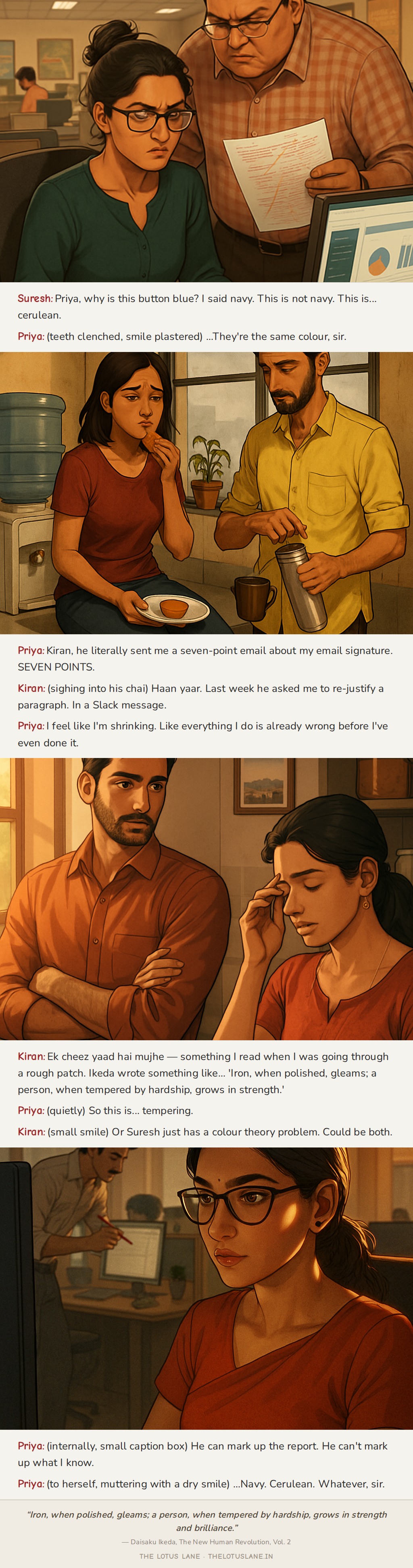
Here's the thing about hustle culture: it never tells you what comes after the hustle. It shows you the highlight reel - the success, the grind, the results - but it skips the part where people quietly fall apart behind closed doors. It skips the anxiety attacks in the car before work. The crying for no reason. The complete inability to enjoy things you used to love. The weird guilt of resting because you feel like you should be doing something.
So you push harder, because that's what you were told to do. And pushing harder when you're already broken doesn't make you stronger. It makes everything worse.
There's a line that stuck with me from a collection of philosophical letters written centuries ago: "Health is not simply the absence of illness. It is a dynamic state of vitality in which we can take on any challenge." What that means in plain terms is this - you're not well just because you haven't collapsed yet. Real health is having something in reserve. Having some life in you. And if you're running on fumes and calling it fine, you're not fine. You're just not dead yet, which is a very low bar.
Admitting you're burned out isn't giving up. It's the first honest thing you've probably said to yourself in a long time.
What's Actually Happening Inside You
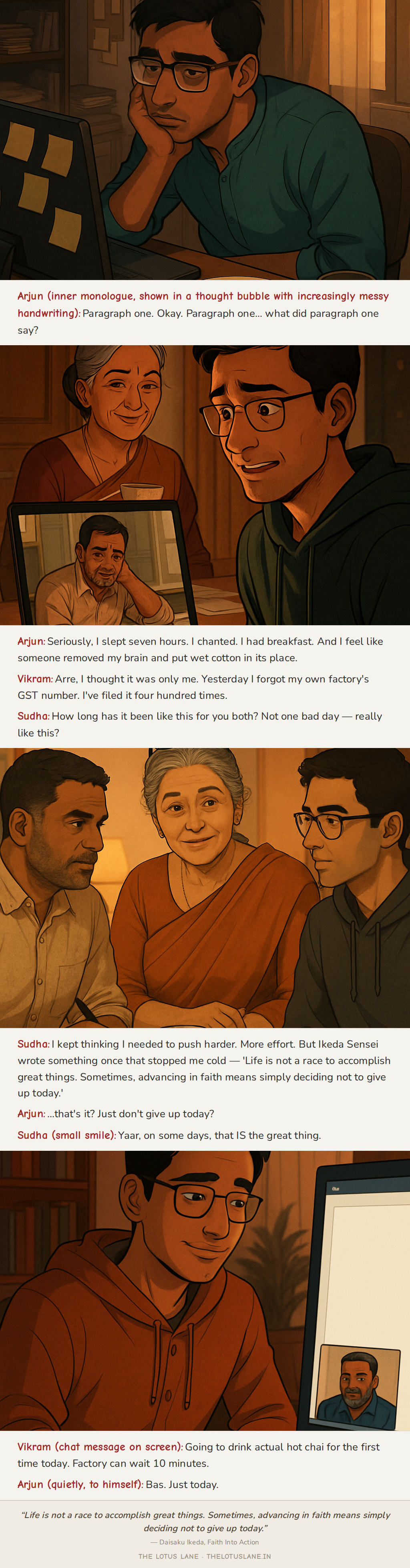
When you're in burnout, your nervous system is stuck in a kind of permanent emergency mode. Your body has been treating ordinary days like crisis situations for so long that it forgot how to come down. That's why you feel exhausted but can't sleep. That's why you feel numb but also weirdly irritable. That's why you can sit down to rest and still feel no relief - because rest without recovery doesn't actually restore you.
Burnout also does something cruel to your sense of identity. So much of who we think we are gets tied up in what we produce, what we achieve, how much we can handle. When you can't handle anything anymore, it can feel like you've lost yourself. Like you've become someone smaller and lesser than the person you used to be.
You haven't. You've just been living in a way that wasn't sustainable, and your mind and body finally said enough.
Small Things That Actually Help (Not a Miracle List, Just Real Ones)
Here's where most articles hand you a neat 10-step plan. This isn't that. But there are small, real things that can start to move the needle - not all at once, not perfectly, but honestly.
Stop performing wellness and start doing one thing. There's a thought that keeps coming back to me from an old philosophical text: "A hundred theories without a single action are worthless. Even one small step taken with determination changes everything." Burnout loves to keep you in your head - reading articles, making lists, planning recovery - without ever actually doing anything. One real thing is worth more than ten plans. What is one thing, just one, that you could do today that would give your body or mind a small amount of relief? Not fix everything. Just one thing.
Sleep is not optional. I know that sounds obvious. But burned-out people are often chronically under-sleeping, either because they can't switch off or because they're using late nights as the only private time they get. Sleep isn't laziness. It's when your brain literally clears out toxins, when your nervous system resets, when you become capable of being human again. If sleep is broken right now, that's the first thing worth addressing - even if it means talking to a doctor.
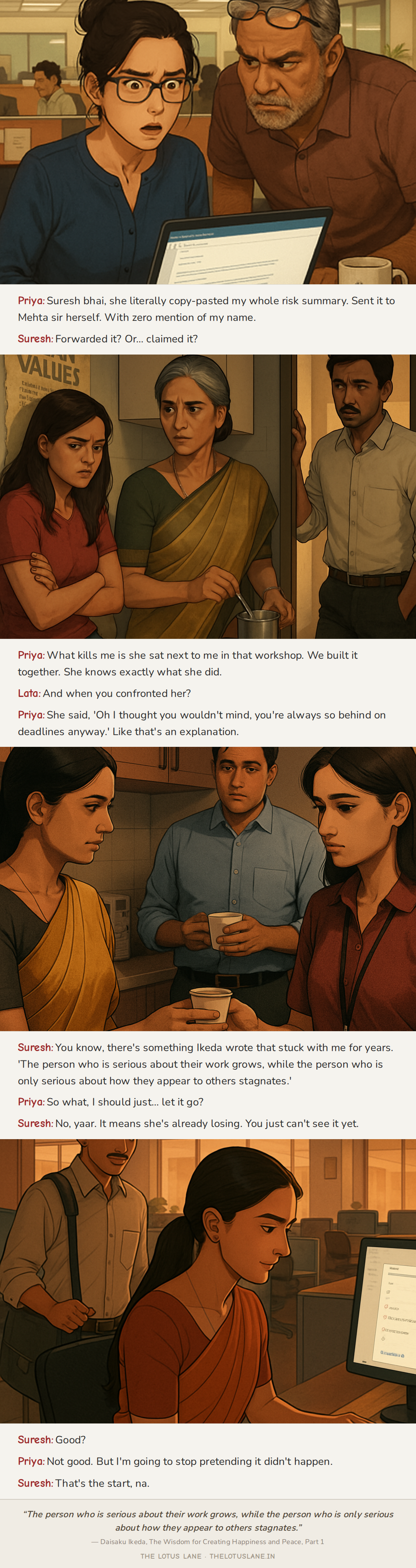
Tell someone the truth. Not the "I'm fine, just a bit tired" version. The real version. Burnout thrives in isolation. It convinces you that everyone else is managing fine and you're the only one struggling, which is a lie, but a convincing one. Find one person - a friend, a partner, a therapist, anyone - and say the actual words out loud. "I'm not doing well. I'm really struggling." That act alone can break something open in a useful way.
Reduce the load, even temporarily. This feels impossible, but usually there are things on your plate that are there out of habit, obligation, or guilt rather than genuine necessity. What is one commitment, one responsibility, one thing you've been doing on autopilot that you could pause, delegate, or drop entirely for the next few weeks? Not forever. Just now, while you recover.
Get outside and move your body, even slightly. Not to lose weight. Not to train for anything. Just because your body is not designed to sit still in artificial light being anxious. Even a fifteen-minute walk outside - actual daylight, actual fresh air - can shift something in your nervous system in ways that are disproportionately helpful for how simple they are.
The Part Nobody Talks About: What Burnout Is Trying to Tell You
There's a perspective I find genuinely useful here, from old philosophical writing that understood suffering not as punishment but as information. One letter puts it plainly: "Through illness, we can deepen our compassion and discover our true strength." That doesn't mean burnout is a gift, or that you should be grateful for suffering - that would be patronising. But it does mean that what breaks you can also show you something true about yourself and your life, if you're willing to look at it.
Burnout is usually telling you something. That the life you were living had some fundamental imbalance in it. That you had been putting yourself last for a very long time. That the way you were measuring your own worth - through output, through productivity, through how much you could endure - was always going to cost you something. The question on the other side of burnout isn't just "how do I recover?" but "what do I want to return to, and what would I rather leave behind?"
That's not something you have to figure out right now, at 2am, when you're running on nothing. But it's worth knowing that you don't have to perfectly reconstruct the old life. The old life is what led here.
You Don't Have to Fix Everything Tonight
Recovery from burnout is slow. It's not linear. There will be days where you feel a little better, and then a day where you feel terrible again, and that's normal - not a sign that you're failing at recovering.
But here's what I want you to know, honestly and without any agenda: the fact that you're here, that you searched for this, that somewhere inside you there's a part still trying to find a way through - that matters. That part of you is still alive. And that's more than enough to start with.
You gave a lot. Probably more than you should have, for longer than was fair. Now it's time to give something back to yourself - not all at once, not perfectly, but gradually and with some patience for who you are right now, not who you think you should be.
Take it one night at a time. Start with tonight. That's enough.