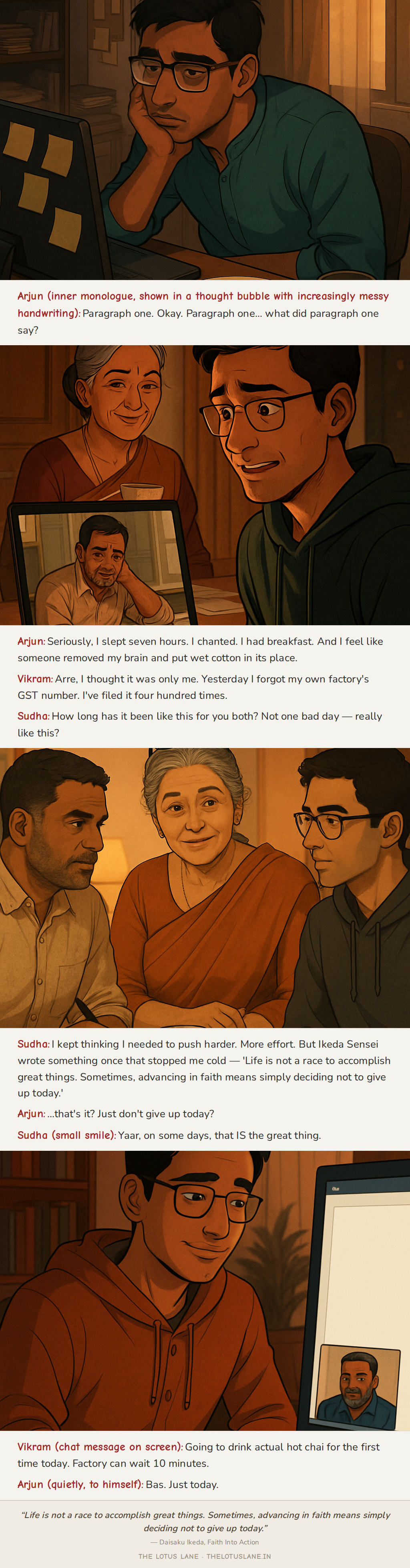
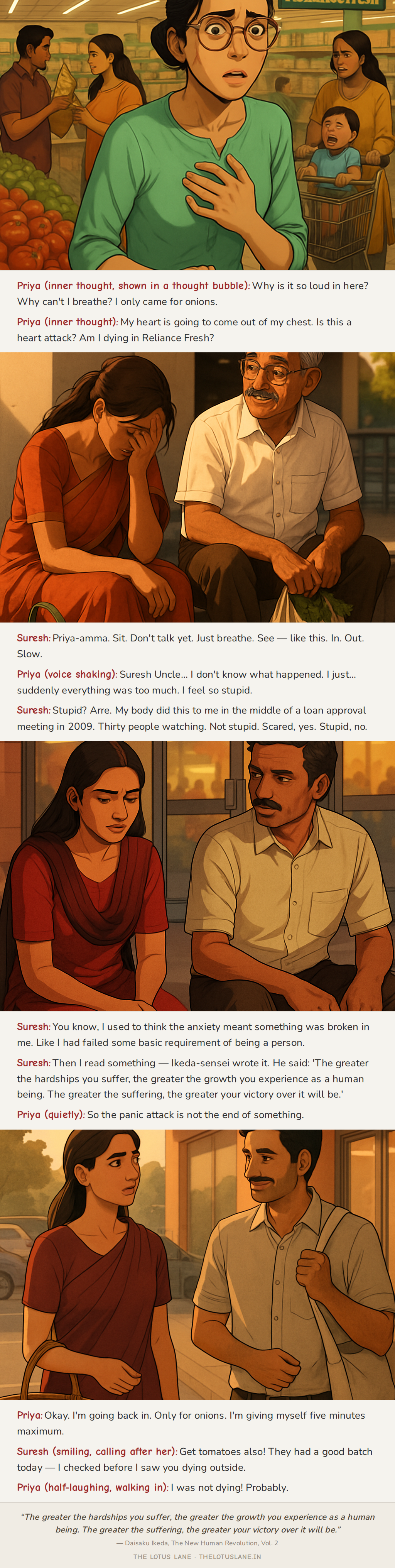
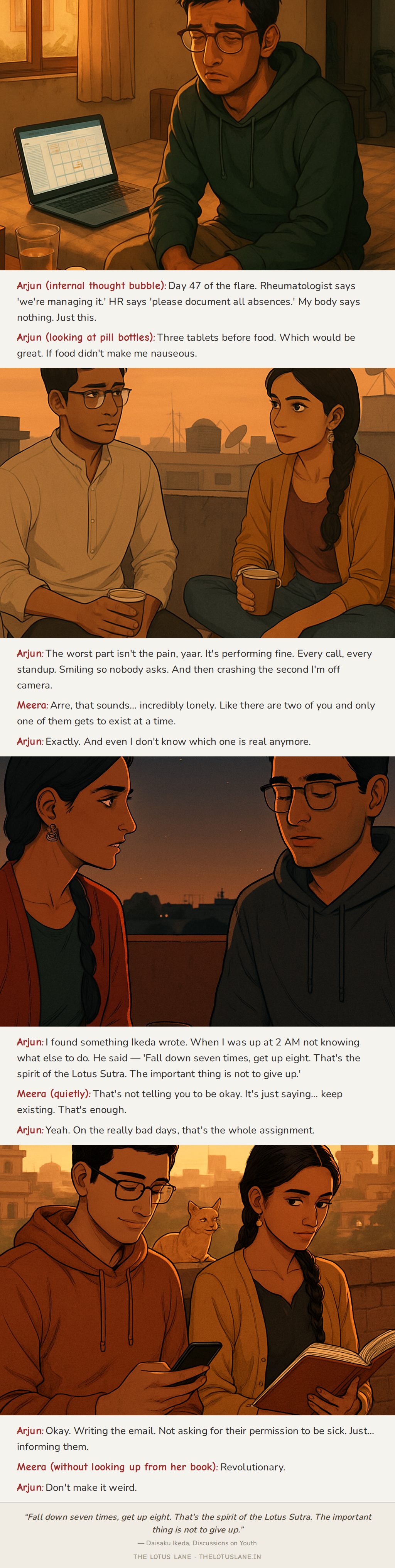
You know that feeling when you wake up and, before you've even fully opened your eyes, the pain is already there waiting for you? Or when a doctor says something in a calm, clinical voice and the words land in your chest like stones? Or when you look at your own hands - the same hands you've had your whole life - and they feel like they belong to someone else, someone you didn't agree to become?
That's where this article starts. Not with five steps to healing. Not with a silver lining. Right here, in the middle of it, where it actually hurts.
When your body is failing you - whether that means a new diagnosis, a chronic condition flaring up, a slow decline you weren't ready for, or simply a body that keeps breaking its promises to you - it doesn't just affect your physical life. It pulls at your identity. It messes with your relationships. It sits at the dinner table with you and follows you into conversations you were trying to have about something else entirely. It can make you feel like a stranger in the one home you were never supposed to lose.
And if you Googled this at 2am, you're probably past the point of needing to be told to "stay positive." So let's talk about what's actually happening, and what - if anything - might help.
The thing nobody says out loud
When the body starts failing, one of the cruelest parts is the grief. Not just for what's lost, but for what you assumed would always be there. We take for granted that our bodies are on our side. We assume some basic loyalty from them. When that breaks down, there's a real sense of betrayal - and grief is the correct word for it, even if no one has died, even if doctors keep telling you things could be worse.
Your grief is real. The anger is real. The exhaustion of having to explain yourself - to medical professionals, to well-meaning family members, to anyone who looks at you and sees someone who "seems fine" - is a specific, grinding kind of tired that healthy people rarely understand.
You're allowed to feel all of that. That's not weakness. That's honesty.
What ancient wisdom actually says about this (not what you'd expect)
There's a letter written in 13th-century Japan - a time without antibiotics, without running water, with an average life expectancy that would shock us today - that includes this line: "Winter always turns to spring. Never, from ancient times on, has anyone heard or seen of winter turning back to autumn."
People quote this and often turn it into a poster about hope. But read it again slowly. It doesn't say winter is short. It doesn't say you'll enjoy winter. It doesn't say spring is just around the corner. It says that the direction of movement - even when you can't feel it, even when you're buried in it - is always forward. Not backward. Never back to a worse season.
That's not optimism. That's something sturdier than optimism. It's a statement about direction when you've lost the ability to feel it.
And from a collection of philosophical guidance written in the 20th century, this: "As long as we have hope, we have direction, the energy to move, and the map to move by." Not happiness. Not health. Just hope - even small, quiet, provisional hope - as the thing that keeps the needle pointing somewhere.
When the body is failing, that needle can feel like it's spinning. These aren't words that fix that. But they're honest about what's needed: not a cure, not certainty, just enough of a direction to take the next small step.
The practical things that actually help
Philosophy can hold you, but it can't hold your hand at 3am when the pain is bad. So here are some concrete things that tend to make a difference - not because they solve anything, but because they give you somewhere to put your hands when everything feels out of control.
Write down what's actually happening - in plain words. Not for anyone else. Just for yourself. "My hip hurts when I walk more than ten minutes and I haven't told my sister because I don't want her to worry and I cried in the car last Tuesday." That kind of writing. It pulls the fog of suffering into something with edges, and things with edges are easier to deal with than shapeless dread.
Find one person who can handle the full truth. Not someone who needs you to reassure them. Not someone who immediately starts problem-solving. Just someone who can sit next to the reality of what you're going through without flinching. If that person doesn't exist in your life yet, a good therapist counts - and specifically, therapists who specialize in chronic illness or health anxiety understand things that general talk therapy sometimes misses.
Separate "today" from "forever." The mind, when it's afraid, collapses time. Today's pain becomes a preview of every future day. Today's limitation becomes a permanent ceiling. This is the brain trying to protect you, but it's doing it badly. Try to build a habit of asking: "Is this true today, or am I making a prediction?" You can take action on today. You can't live inside the future.
Get very, very specific about what you can still do. Not as a gratitude exercise. As a practical map. What can you do today that matters to you? Maybe it's smaller than it used to be. Maybe it looks completely different. But the question "what can I actually do?" is more useful than the comparison to what you used to be able to do. The comparison is a trap. The question is a door.
Ask better questions of your medical team. "What should I expect?" and "What are my options?" are good, but also try: "What would make this more manageable, even if it doesn't fix it?" and "What do people in my situation often wish they'd known sooner?" Doctors respond differently to those questions. They're used to being asked to cure things. Sometimes the most useful information lives in the space between curing and suffering.
On the fear underneath everything
Sometimes when the body is failing, what we're really circling is a bigger fear - the fear of what this means about our time, our mortality, our smallness in the face of things we can't control.
That fear deserves to be taken seriously, not pushed aside with reassurance.
One collection of philosophical writing puts it plainly: "Life and death are the two faces of the same coin. To understand life, we must understand death. To conquer death, we must live fully."
Living fully doesn't mean living without limitation. It doesn't mean being heroic about your illness or "fighting" it in the way sports metaphors suggest you should. It means being actually present in the life that is happening - which, when your body is struggling, is a more radical act than it sounds. It means not outsourcing your entire sense of self to the question of what's wrong with you physically.
You are not your diagnosis. You are not your worst symptom. You are not the sum of what your body can or cannot do. That sentence is easy to write and very hard to feel as true - but it is true, and it's worth sitting with.
When things are really dark
If you're at the point where things feel not just painful but genuinely hopeless - where the idea of tomorrow feels impossible rather than just hard - please reach out to someone. A doctor, a crisis line, a person who knows you. That level of darkness is not something to manage alone with philosophy or articles at 2am. It needs a human being on the other end of it.
In India, the iCall helpline (9152987821) offers mental health support. The Vandrevala Foundation helpline (1860-2662-345) operates 24 hours. Please use them if you need to.
A last thought
If you made it to the end of this, I want to say something directly: what you're carrying is genuinely hard. Not "hard but beautiful." Not "hard in a way that will make you stronger." Just hard, in the way that being human sometimes is - full of limitation and uncertainty and a body that doesn't always cooperate.
You don't have to make meaning out of this right now. You don't have to be okay. You just have to get to tomorrow, and then the day after that. Winter always turns to spring - not quickly, not painlessly, but always, always forward.
That's enough to hold onto tonight.